It’s 7am, the cobbles are still wet, and you’ve got an hour before the tour groups reach the centre. The...
Share This Article
It’s 7am, the cobbles are still wet, and you’ve got an hour before the tour groups reach the centre. The Belfry is already catching the light and every lane seems to promise a better angle. Where do you point your camera first?
The best photo spots in Bruges sit close together, but they don’t all work in the same light. A canal reflection needs calm water, which you stand the best chance of finding early. Whitewashed houses look better under cloud than in harsh sunshine. The famous tower shot gets awkward once you’re sharing the pavement with everyone else.
Work the central squares first, head south towards the water and gardens, then decide whether you’ve got the energy for the windmill detour. The locations below follow that sequence and finish back near the centre, so you can shoot one efficient morning or evening rather than wandering between stops.
You don’t need to squeeze every spot into one session. I’d rather shoot five well than ten in a rush.
For postcard views: Prioritise Markt, Burg and Rozenhoedkaai before the busiest part of the day.
For quieter photographs: Leave room for the Begijnhof and the outer ramparts rather than chasing another crowded bridge.
For the busy hours: Expect to shoot handheld, because pavement space disappears fast once the centre fills up.
If you’re staying at St Christopher’s Bruges, the historic centre is close enough for early starts and evening shoots. Afterwards, The Bauhaus is a natural place to swap shots with fellow travellers.
1. Markt and the Belfry of Bruges
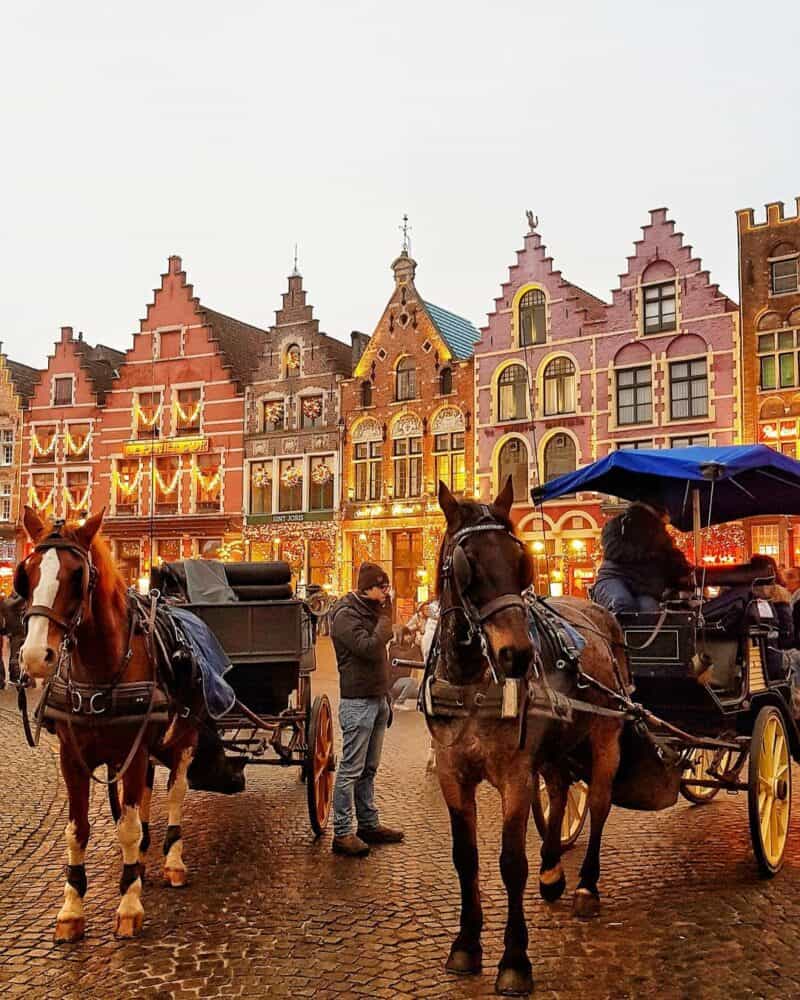
Start with space around you. Markt gives you enough room to work out your framing without balancing against a canal railing, and the Belfry makes an obvious subject while you get your bearings.
The Belfry rises 83 metres, according to Visit Bruges’ sights guide, which also identifies its panoramic view over the city. From ground level, the challenge is keeping that height without making the surrounding buildings lean dramatically.
Give the tower some breathing room
Work from the opposite side of the square rather than directly beneath the tower. Hold your phone level and leave room around the top for straightening the image afterwards. An ultrawide setting fits more in, but it can stretch buildings near the edges.
Early morning suits a broad architectural view. Later, café furniture and passing visitors become part of the scene, so switch to tighter compositions rather than waiting indefinitely for an empty square.
Watch the light: Low sunlight from the east or west picks out different façades. Walk around the square before committing to a position.
Try a street frame: If the square feels cluttered, use an approach street to frame the tower between buildings.
Treat the climb separately: Check current admission, opening times and access arrangements before planning your morning around a shot from up high.
Say you’ve arrived with only your phone. Make a level, wide photograph first, then isolate the gables with the standard camera rather than digitally zooming into distant details.
The guide to Bruges Market Square adds context for a return visit. For now, finish your opening shots and head towards Burg.
2. Burg Square with the Town Hall and Basilica of the Holy Blood
Burg is where you stop trying to fit everything into the frame. The Town Hall’s carved façade, the Basilica’s entrance and the surrounding civic buildings offer more detail than a single wide photograph can comfortably hold.
Stand towards the far side of the square for the Town Hall’s full width. Then move closer and look for a doorway, a row of statues or a lamp set against the stonework. Don’t confuse the civic buildings here with the Provincial Court back on Markt.
Work with shade, then return for warmth
A quiet morning is useful for clean compositions, but it doesn’t guarantee warm light on the façade. Later sunlight arriving from the west can bring out the relief in the stonework, depending on the season and surrounding shadows. If the building is shaded, photograph its patterns rather than forcing a golden-hour look.
For a typical travel sequence, take a broad view from the corner, a tighter architectural detail and an entrance framed by neighbouring masonry. That gives you variety without filling your camera roll with near-identical façades.
Practical rule: At Burg, move your feet before switching to your widest lens. Extra distance usually gives you cleaner architectural proportions.
The Basilica makes a useful change of pace when it’s open. Check the posted photography rules before taking out your camera, and keep worshippers out of your composition unless they’ve agreed to be photographed. In dim interiors, brace your elbows and raise ISO rather than assuming you can use flash or a tripod.
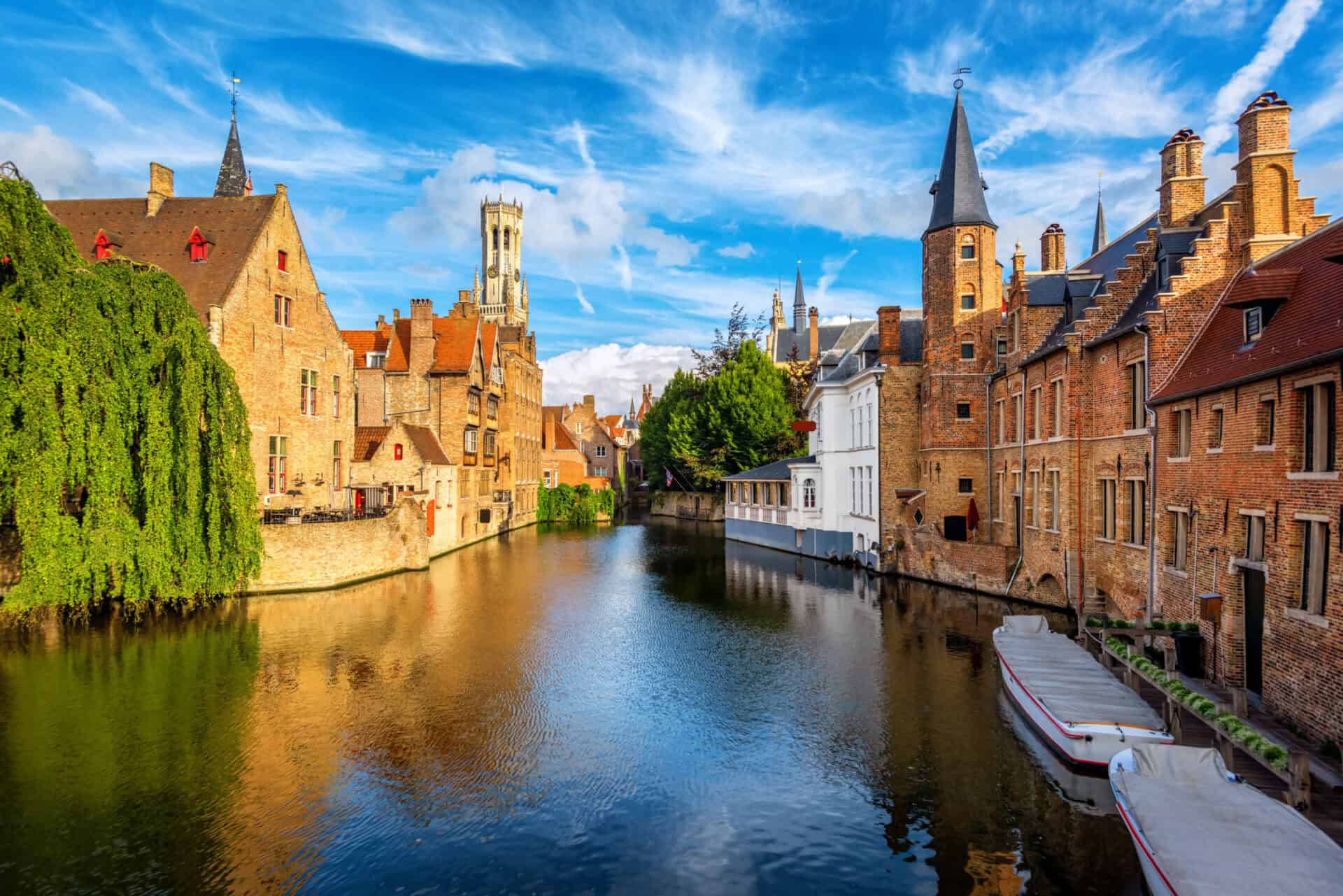
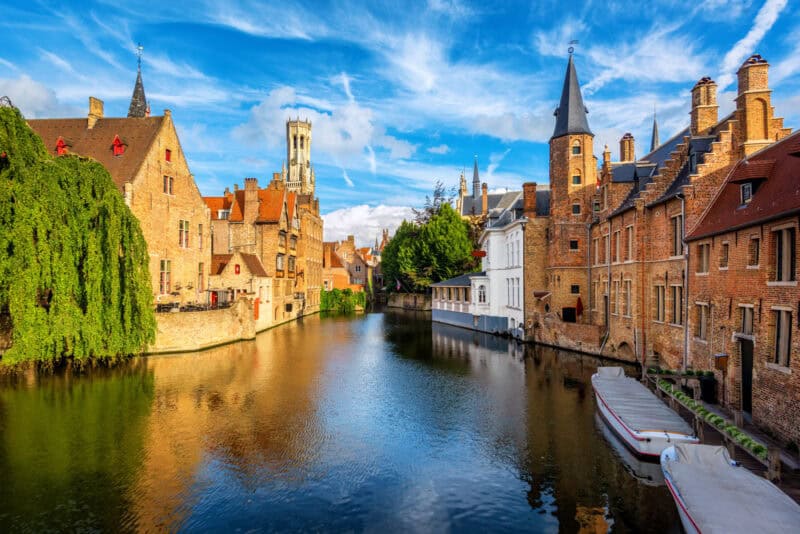
The canal bend leads your eye towards historic façades and the Belfry beyond. Start with that familiar composition, then check the edges for branches, signs and cropped rooflines. A slightly tighter frame often looks stronger than an ultrawide photograph containing every possible landmark.
Reflections matter more than the clock
Just after sunrise is a good starting point for fewer people and potentially calmer water. It isn’t a promise of a mirror reflection. Wind and boat movement matter more, so watch the surface before setting up.
For morning light: Keep bright sky under control and expose for the façades. A glowing sky isn’t useful if the buildings become unreadable.
For blue hour: Shoot while there’s still colour in the sky and the building lights balance with it. Don’t rely on a fixed interval after sunset.
For phone photography: Brace the phone securely and use its night mode if needed. Never balance it unsupported above the canal.
Say a boat has just passed through your reflection. Take a photograph with the ripples as texture, then wait for the water to settle rather than immediately changing location.
A tripod helps after dark, but only if there’s room to keep its legs out of the walking line. If the pavement is busy, shoot handheld or return later. Keep a microfibre cloth handy for drizzle and condensation.
4. Minnewater (Lake of Love) and Minnewater Park
After the enclosed streets, Minnewater gives you room to simplify. Water, willows and the bridge make softer compositions than the tightly packed façades around Markt.
Follow the water’s edge and test different relationships between the bridge and its reflection. Don’t assume the first open patch of bank gives the best angle. A small change in position can separate a tree trunk from the bridge or remove a distracting patch of bright sky.
Use the willows as a frame
Late afternoon can bring warm light across the foliage, but check which bank is actually illuminated. Photograph towards the light for glowing leaves and silhouettes, or keep the sun behind your shoulder for clearer colour and detail.
On an overcast day, tighten the composition around water and greenery. A blank sky adds little, while wet leaves and subdued reflections can look lovely.
Include wildlife naturally: Let swans enter the frame themselves. Don’t feed, chase or crowd them for a photograph.
Choose the right shutter speed: Use a faster exposure for moving birds. Save long exposures for scenes where you want the water softened.
Keep portraits simple: Ask a walking companion to stand where the background is uncluttered, not on a narrow bridge where others need to pass.
For example, if the bridge view is busy, photograph a swan against dark reflected trees instead. Expose carefully for its white feathers so they retain texture.
Minnewater also works when the weather turns cold and muted. The guide to why Bruges is magical in winter offers inspiration beyond the usual sunny canal scene. The nearby Begijnhof makes a natural next stop, subject to access.
5. Begijnhof (Beguinage)
Cloudy weather is an advantage here. Soft light keeps the whitewashed façades manageable and lets you photograph the enclosed garden without deep shadows cutting across every composition.
The Princely Beguinage Ten Wijngaarde was founded in 1245, according to Visit Bruges’ culture and heritage guide. Its quiet setting feels quite different from the busy canal viewpoints, but it remains a living religious and residential place, not an outdoor photography studio.
Photograph from the paths
Stay off the central lawn, even if stepping onto it would give you a tidier symmetrical view. Use a path edge to line up the houses, or let the curve of a walkway lead into the scene. Keep voices low and avoid lingering beside residents’ windows.
Morning can be calm, but check the entrance information rather than assuming the grounds are accessible whenever you arrive. If the gate is closed, photograph the approach and return during permitted hours.
A peaceful photograph isn’t worth disturbing the people who live in it.
For a simple worked example, place a nearby tree at the edge of your frame and let the white houses sit beyond it. This adds depth without needing a dramatic sky or a person posed in the courtyard.
A standard phone camera is usually more useful than portrait mode for these architectural scenes. Artificial background blur can cut awkwardly around branches and rooflines, so keep the natural depth instead.
If sunlight breaks through, meter for the white walls and check that they haven’t lost detail. A darker garden is easier to recover than featureless white masonry. Keep your kit compact, and ask before making a recognisable portrait of anyone you encounter.
6. Dijver Canal with the Church of Our Lady
The Dijver is a good place to make a layered photograph rather than another straight-on building portrait. Look for water in the foreground, trees across the middle and the Church of Our Lady’s spire rising above the roofs.
From the Minnewater and Begijnhof area, work back towards the centre along the museum quarter. The Gruuthuse and Groeninge surroundings give you architectural details between the broader canal views. Don’t feel obliged to turn every museum frontage into a separate stop.
Separate the spire from the trees
Try the view along the water from the Wollestraat bridge, then compare it with positions along the bank. Move sideways until branches stop cutting across the spire. That small adjustment often matters more than changing lenses.
Late afternoon can warm exposed brickwork, although nearby buildings and trees may shade the canal itself. Use the contrast deliberately: darker water can make a lit tower stand out. Under cloud, look for colour and repetition rather than directional light.
For a reflection: Wait for calmer water and leave enough space beneath the reflected spire.
For passing boats: Choose either a clean architectural frame or a deliberate boat photograph. A half-cropped boat rarely improves the scene.
For a rainy spell: Look for reflections in wet paving, while keeping your equipment and the walking route clear.
Say the trees hide most of the tower from your first position. Instead of forcing a wide view, use a standard zoom to isolate the visible spire above the roofs, with a narrow strip of canal below.
The Church of Our Lady is also worth considering as an indoor visit, but don’t build your outdoor route around assumed opening hours. Check current access and photography arrangements separately. Rozenhoedkaai is nearby if you want to compare the water and light before continuing.
7. Sint-Janshuismolen Windmill
This is the detour, not a quick stop between neighbouring canals. Head towards Kruisvest through the Sint-Anna area when you want open sky, grassy slopes and a subject that doesn’t depend on another Belfry reflection.
Sint-Janshuismolen offers a different silhouette from the city’s churches and gables. Visit Bruges’ mapped photography walk includes its mound among the city’s viewpoints, alongside central canal locations.
Choose silhouette or surface detail
Walk around the mound before shooting. With the sun behind you, the mill’s structure is easier to read. With the sun behind the sails, you’ll get a stronger silhouette but less detail in the body.
A blue sky works, though a bank of textured cloud can be more interesting. Leave space around the sail tips and check that they don’t merge awkwardly with trees or neighbouring structures.
For a typical composition, shoot from lower on the path so the grassy slope leads towards the mill. Then move farther back and use a longer lens to make the structure stand out more against the rampart scenery. On a phone, use an optical telephoto camera if available rather than heavy digital zoom.
Skip it when you’re rushed: The windmill adds variety, but it’s the first stop to drop if reaching it means missing the evening light you wanted in the centre.
The slope is a real consideration if you have limited mobility or heavy kit. You can still work from lower paths without climbing for the standard high angle.
Check current opening arrangements if you want to go inside. For exterior photographs, concentrate on changing light and sail placement, then return towards the centre through the quieter streets.
8. Huidenvettersplein (Tanners’ Square)
Don’t come to Huidenvettersplein expecting an undiscovered corner of Bruges. It sits beside the popular canal area, and restaurant activity and passing visitors can make it busy. Its value is the smaller scale, not guaranteed solitude.
Use it as your return towards the centre after the windmill detour, or photograph it alongside Rozenhoedkaai if you’re keeping the walk short. The enclosed square suits details, gables and glimpses towards the water better than a sweeping cityscape.
Keep the square and canal compositions separate
Inside the square, look for rhythm in the windows and rooflines. Near the adjoining canal viewpoint, use the water for reflections and leading lines. Trying to fit both scenes into an extremely wide frame usually gives you too much paving and too little subject.
Early morning offers the best chance of fewer obstructions. Later, check where low sunlight reaches the upper façades while the square remains shaded. Expose for the brighter masonry rather than lifting the entire scene until the sky disappears.
For architectural details: Keep the phone level and crop deliberately around a doorway, sign or gable.
For everyday atmosphere: Include café activity only when it helps explain the place. Ask before taking close portraits.
For evening photographs: Work handheld when people are moving around you, or tuck a compact tripod into a genuinely clear space.
Say tables and umbrellas dominate the lower half of your frame. Don’t spend the session trying to hide them behind someone else’s shoulder. Crop upwards to the roofline, or make a deliberate street scene that includes the activity.
Keep noise down in adjoining lanes and don’t lean equipment against doors. From here, you’re well placed to finish at Rozenhoedkaai or walk back towards Burg and Markt.
Bruges photo spots at a glance
Pick a start point, then stay with the strongest light instead of ticking off landmarks.
Item
Best time to shoot
Crowd level
Entry cost
Best for
Markt and the Belfry of Bruges
Before 8am or after 8pm
Very busy late morning to early evening
Square is free; Belfry climb is paid, check current rates
Iconic square and panoramic rooftop views
Burg Square with the Town Hall and Basilica of the Holy Blood
Early morning or golden hour
Quieter than the Markt
Square is free; check Basilica access
Gothic architecture and close- up details
Rozenhoedkaai (Rose Hedge Quay)
Just after sunrise or blue hour
Extremely busy
Free
Classic canal reflections and Belfry views
Minnewater (Lake of Love) and Minnewater Park
Late afternoon
Calm, less crowded
Free
Swans, willow reflections and romantic scenes
Begijnhof (Beguinage)
Early morning
Usually quiet
Free
Peaceful, symmetrical courtyard compositions
Dijver Canal with the Church of Our Lady
Late afternoon
Quieter than the Markt; some pedestrian traffic
Promenade is free; the church has an admission charge, check current rates
Canal, greenery and historic architecture
Sint-Janshuismolen Windmill
Clear days, especially with good light
Quiet and less touristy
Outdoor views are free; check mill access
Windmill and ramparts against open sky
Huidenvettersplein (Tanners’ Square)
Early morning or golden hour
Moderate, quieter early on
Free
Colourful canal houses and reflections
Planning Your Bruges Photo Route Without the Rush
Start at dawn in Markt, then walk to Burg while the squares are still workable. Rozenhoedkaai is close enough to reach before the day builds; if the canal is calm and the reflection is clean, stay with it rather than leaving just because another landmark is on your list. A phone handles the compact view well, while a tripod needs a narrow stance on the bridge and patience when people bunch at the rail.
For the most efficient central session, photograph Dijver alongside Rozenhoedkaai and Huidenvettersplein. The numbered order keeps the southern garden stops together, but a good canal composition is worth taking when the light and a gap in foot traffic arrive. You can loop back through the centre on foot.
Pick the route that matches your energy
For a focused morning: Stay with Markt, Burg, Rozenhoedkaai, Huidenvettersplein and Dijver. Finish near the centre without the outer detour.
For a longer walk: Continue south to Minnewater and the Begijnhof, then return through the museum quarter. Add Sint-Janshuismolen only if you still want the extra walking.
For an evening session: Start with the windmill or Minnewater while there’s directional light, then finish centrally at Rozenhoedkaai or Markt as the sky darkens.
Saving Minnewater, the Begijnhof and the windmill for later can spread your day out, but they won’t all have matching light. The Begijnhof often works better under cloud than in strong sunshine, and its access arrangements matter more than sunset. I’d treat the windmill as the optional leg on a short central loop, since it asks for the most extra walking for one open-sky composition.
Bruges welcomed 8 million day and overnight tourists to its historic city centre in 2024, according to the City of Bruges tourism office. That volume argues for timing your shots early or late; a cyclist, a boat or a café scene can give your photographs more character than another empty pavement.
Pack for wet cobbles and changeable light
Bring a microfibre cloth, a rain cover and a spare battery or power bank. Wear shoes with grip, keep your bag closed while shooting and avoid backing into the road for a wider angle. Uneven cobbles, bridge approaches and the windmill mound deserve extra thought if you need a step-free route; when space is tight, brace a phone on the rail instead of opening tripod legs across the walkway.
Check the Belfry’s current opening times before climbing. Let the light set your shooting order, rather than trying to collect every location before breakfast.
St Christopher’s Bruges gives you a social base for early canal walks, with an on-site bar for meeting fellow travellers after your evening shoot. Visit St Christopher’s to explore the Bruges accommodation and plan your stay around the photographs you want to make.
Our direct rates are guaranteed to be at least 5% cheaper than anywhere else online, with a free drink on arrival, 25% off food at the bar, and free cancellation options available.