Best Travel Backpacks for Backpacking: A Practical UK Guide
Phill
The most popular backpack advice starts with the wrong question. It asks which brand has the most pockets, the toughest...
Share This Article
The most popular backpack advice starts with the wrong question. It asks which brand has the most pockets, the toughest fabric or the highest litre capacity. For UK travellers hopping between European cities, the first question should be simpler: will this bag fit the airline allowance I'm using, and can I carry it comfortably from the station to my hostel?
A backpack that works brilliantly on a remote trek can be a frustrating choice for a budget flight and a week of hostel moves. The best travel backpacks for backpacking are shaped by cabin rules, trip length, packing habits and fit, not by marketing language. Get those decisions right and your bag becomes background equipment. Get them wrong and every train platform, cobbled street and dorm staircase reminds you.
Why Most Backpack Buying Advice Gets It Wrong
The wrong backpack can ruin a cheap European city break before you reach the hostel. Capacity, pockets and fabric matter only after the bag clears your airline's rules and remains comfortable on foot. For UK-based travellers, that makes the smallest cabin allowance on the itinerary the starting point, not an afterthought.
Capacity is only useful when the bag travels well
More space encourages more packing. A larger pack can also exceed a free allowance, become awkward on public transport and turn a straightforward city transfer into a tiring carry.
For most UK-based backpackers, 35 to 45 litres covers a weekend through to a week of light hostel travel while staying near common cabin-bag limits. UK review guidance places a long weekend at around 30 to 40 litres, with 40 to 50 litres better suited to longer trips, according to this UK travel backpack sizing guidance.
The label on the product page does not show how the packed bag behaves. A boxy 40-litre pack may fail a sizer where a slimmer bag with the same stated capacity passes. Bulging pockets, compression straps, a rigid frame and overfilling the top all increase its real dimensions.
Practical rule: Buy for the smallest allowance on your itinerary, not the most generous one.
Hostel travel changes what matters
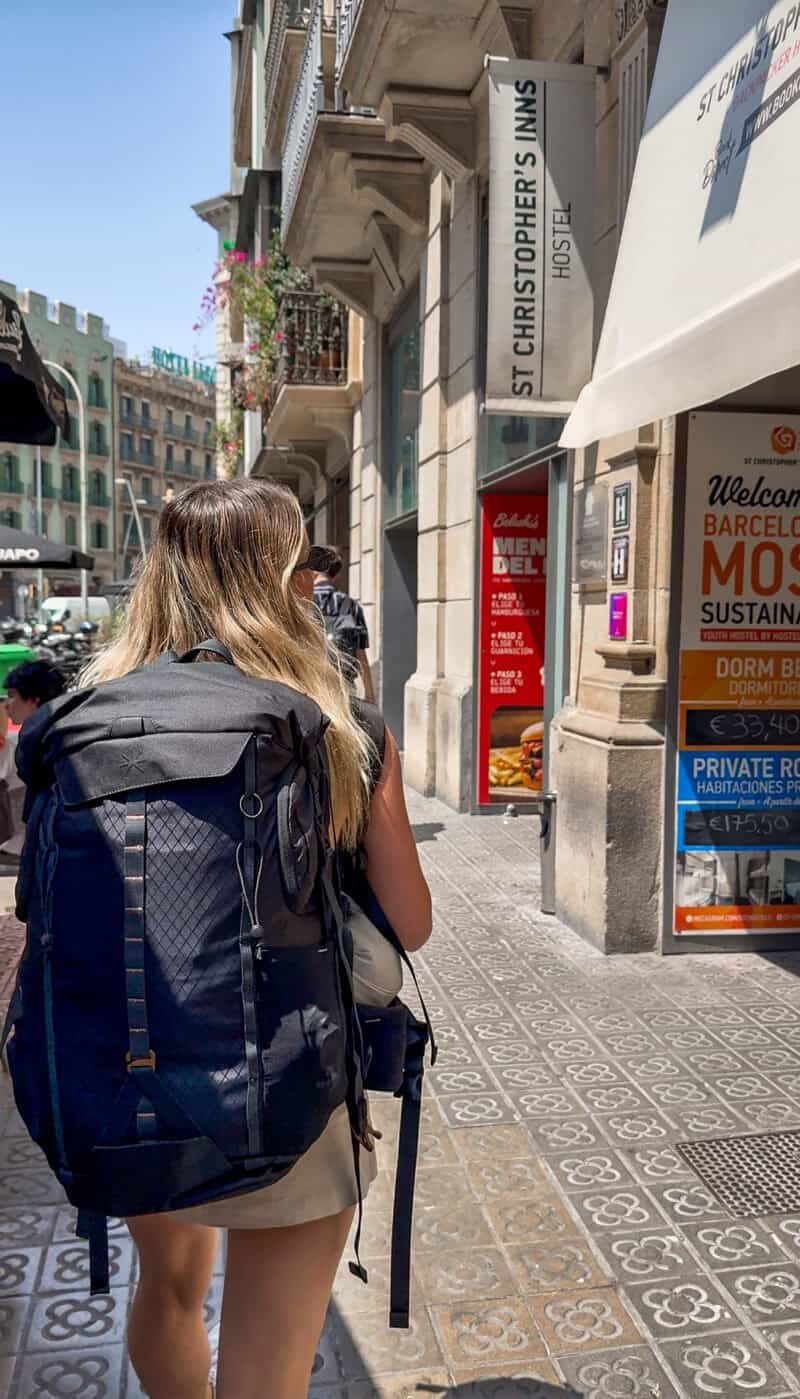
Hostel trips reward quick, controlled movement. You will walk from a railway station, lift the bag onto a luggage rack, squeeze through a crowded tram and open it beside a dorm bed. A front-opening design, lockable zips and sensible internal organisation usually serve that routine better than numerous exterior attachment points.
The UK bags and containers market generated USD 1,428.5 million in 2024, and backpacks made up 42.51% of revenue, according to this UK backpack market analysis. That market gives buyers plenty of styles and price points, but the choice still needs to match the route. Comparing features without considering airline checks, station changes and dorm storage leads to the wrong purchase.
A compact, well-designed pack keeps one outfit, toiletries, electronics and travel documents organised without spreading your belongings across the bed. It also keeps both hands free, which helps on uneven pavements, crowded public transport and hostel stairs. Choose the bag that fits the journey, then pack within its limits.
How Budget Airline Rules Dictate Your Backpack Size
Airline limits decide whether your backpack stays convenient or becomes an unexpected cost. A bag marketed as cabin-friendly can still fail as a free personal item on a budget carrier. Check the allowance attached to your ticket, then measure the fully packed bag, including bulging pockets and compression straps.
The allowances that affect UK travellers
British Airways permits a main cabin bag up to 56 × 45 × 25 cm, including wheels and handles, according to its cabin baggage requirements. Its Joint Business guidance also gives a personal item allowance of 40 × 30 × 15 cm when that rule applies, as set out in the airline's carry-on baggage allowance.
Ryanair and Wizz Air cause the most trouble on European city-hopping routes. Their free under-seat option uses a smaller 40 × 30 × 20 cm personal item, while a larger cabin bag requires the relevant paid allowance. A 40 litre travel pack may fit an overhead locker but still be too large to take free under the seat.
Airline
Free personal item
Paid cabin bag
British Airways
40 × 30 × 15 cm
56 × 45 × 25 cm
Ryanair
40 × 30 × 20 cm
Check the allowance attached to your ticket
Wizz Air
40 × 30 × 20 cm
Check the allowance attached to your ticket
Use the exact rule for your fare and flight. Airlines can change allowances, and fare type affects what you may bring.
Choosing a size without paying for empty air
For European city hopping, 35 to 45 litres is the sensible middle ground. That capacity can hold a compact wardrobe, wash kit, shoes and electronics without forcing you into a tall, awkward shape. More restrictive airline dimensions can reduce the usable capacity of a bag, so check its external measurements rather than trusting the litre rating alone.
If you want a free under-seat item, choose a compact bag instead of stuffing a larger one until the fabric bulges. For a paid or included overhead cabin bag, a structured 40 litre clamshell pack is easier to organise and compress than a tall trekking bag.
Measure the pack after packing it the way you’ll travel. Empty dimensions tell you almost nothing about whether it will pass a gate check.
Cabin contents matter too. Liquids must be in containers of 100 ml or less, with a total cabin allowance of 1 litre, under British Airways’ Joint Business guidance. The UK Civil Aviation Authority says spare batteries, vapes, e-cigarettes and power banks belong in the cabin, and limits passengers to two power banks each, as explained in its safe flight baggage guidance.
A compact backpack that fits the strictest allowance will save more hassle than extra capacity you cannot use. Check every flight before packing, then keep the bag within its measured limits.
Understanding Fit and Load Transfer for Real Comfort
Padding alone doesn’t make a backpack comfortable. Load transfer does. A pack that matches your torso and moves weight towards your pelvis can feel far easier than a larger bag that leaves everything hanging from your shoulders.
Start with your torso, not the litre count
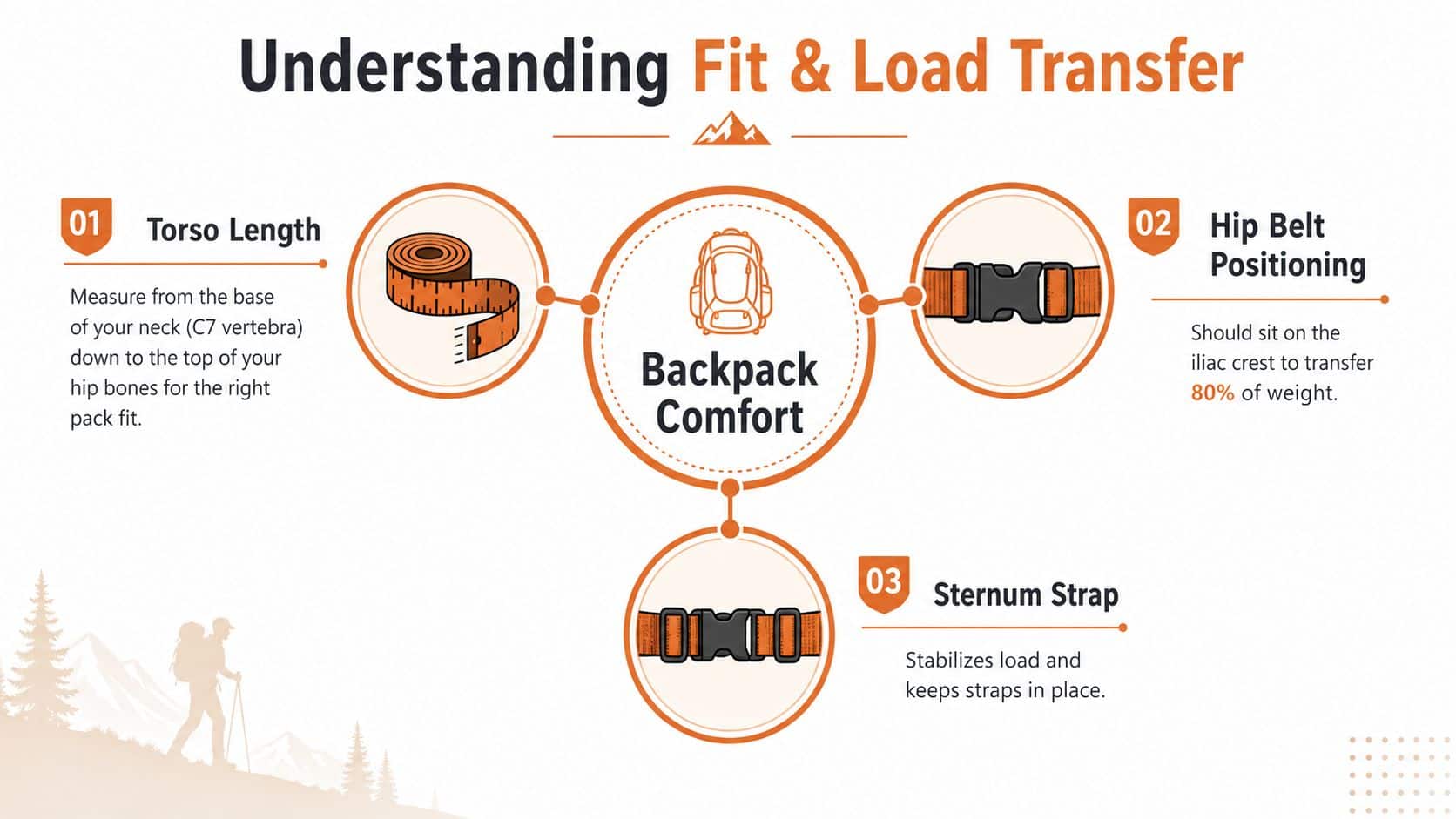
Torso length runs from the base of your neck to the area where the hip belt should sit. Adjustable back systems are useful because people of the same height can have different proportions. If the shoulder straps pull backwards, or the hip belt sits above your hip bones, the pack isn’t transferring weight properly.
UK outdoor buying guidance places 50 litres and above in true backpacking territory, with 50 to 65 litres commonly suited to 3 to 7 night trips. It also stresses that a well-fitted 40 to 50 litre pack can carry more comfortably than a poorly fitted 60 litre model, as detailed in this backpacking pack fit guidance.
Adjust the load in the right order
Put the heaviest items close to your back and around the middle of the pack. Then loosen every strap before putting the bag on.
Set the hip belt first. Position it over the bony ridge of your pelvis, not around your stomach. Tighten it until the bag feels supported without restricting your breathing.
Pull the shoulder straps down and back. They should sit close to your body, with no large gap behind the shoulders.
Clip the sternum strap. Set it across the chest at a comfortable height. It should stop the shoulder straps sliding outwards, not squeeze your chest.
Use the load lifters carefully. If the pack has them, tighten them enough to bring the upper bag closer, but don’t crank them so hard that the shoulder straps lift away.
Try the bag loaded, walk around and climb a few steps. Spend enough time wearing it to notice pressure points. Red flags include numb fingers, a hip belt that slips down, shoulder straps that dig into your neck and a back panel that forces you into a hunched position.
Matching Backpack Types to Your Travel Style
There isn’t one universal winner. A compact city pack, a front-opening cabin pack and a trekking model solve different problems.
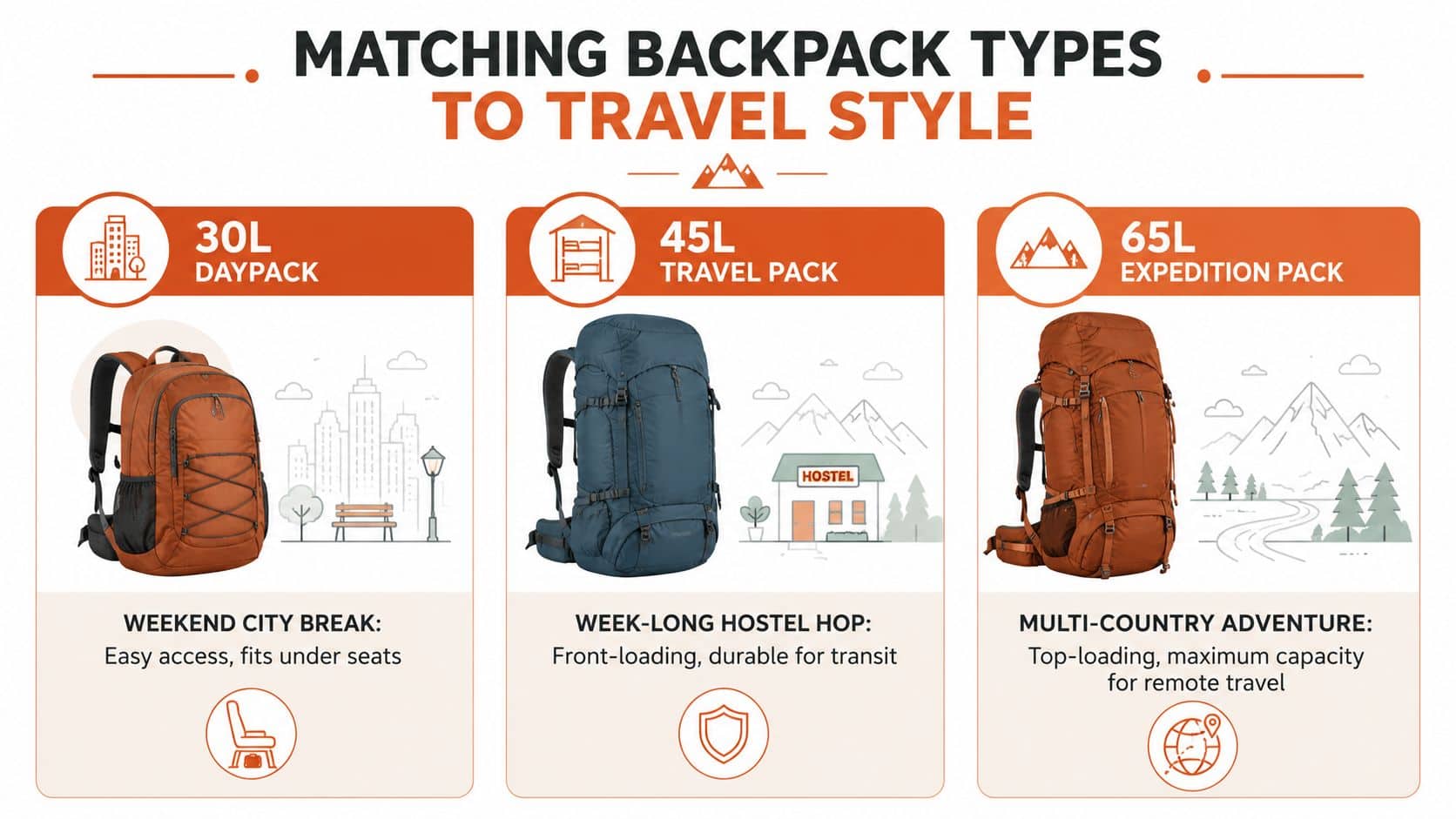
Weekend city breaks
A 30 litre daypack works when you’re travelling light and prioritising easy access. It can suit an under-seat strategy, although you must check its loaded dimensions against the airline. Its weaknesses appear when you need extra shoes, bulky layers or several travel days between washes.
Choose this category for a short city break, a personal item only itinerary or a trip where your accommodation is a fixed base. It’s light, discreet and simple to carry through museums, cafés and public transport.
Week-long hostel hops
A 40 to 45 litre travel pack is my default recommendation for UK to Europe backpacking. Look for a suitcase-style clamshell opening, a real hip belt, compression straps and a protected space for electronics. This category handles a compact week-long load while making it easy to pack in a dorm without emptying the whole bag.
The trade-off is discipline. You won’t have room for a full wardrobe, multiple pairs of trainers and equipment for every possible weather condition. That limitation is useful. It forces you to choose clothing that works together and keeps the pack within a realistic cabin profile.
A 50 to 65 litre trekking pack makes sense when you’re carrying camping equipment, colder-weather clothing or supplies that European hostel hopping doesn’t require. UK guidance places larger capacities in multi-day and expedition territory, but the increased volume can make flights and city transit less convenient.
Top-loading designs distribute gear well on trails, yet they’re slower in a dorm. You’ll need packing cubes or separate dry bags so the item at the bottom doesn’t become a daily excavation project. For hydration systems, fit and cleaning matter too, so these hydration pack maintenance and fit tips are useful if you’re adding a bladder to a trekking setup.
Packing Strategy and Security for Hostel Life
The best hostel backpack is organised for dorm routines, not just airport transfers. Choose a layout that gives fast access to daily clothing while separating valuables, footwear and laundry.
Clamshell access wins in dorms
A clamshell backpack opens flat, letting you see your clothes without emptying the bag. That matters when another traveller is sleeping below your bunk and you need a clean top without rummaging around.
Use separate pouches for underwear, tops, cables and toiletries. Keep a small grab pouch near the top for your passport, earplugs, charging cable and medication. Store shoes in a washable bag at the base or against the outer wall, away from clean clothing.
Top-loading packs work well on walking routes because they are often narrow and stable. Their slower access makes them less practical in hostels. If you choose one, pack by category and position frequent-use items near the opening.
Security comes from habits and hardware
Look for lockable zip pulls, an internal valuables pocket and dimensions that fit a hostel locker or under-bed storage. A lockable zip makes casual access harder and keeps the bag closed on crowded trains and buses, although it does not replace sensible habits.
Keep your passport, cards and electronics together while changing cities. The CAA’s cabin guidance supports keeping phones, tablets and laptops in the cabin, unless completely switched off and protected from damage. The CAA’s cabin baggage guidance makes a dedicated electronics sleeve a practical feature rather than decoration.
For durable travel gear recommendations, prioritise repairable construction, strong zip tracks and fabric that tolerates station floors. St Christopher’s properties provide storage such as under-bed lockers or cages, along with luggage storage before check-in and after check-out. That setup suits travellers crossing cities with one main backpack.
Use this hostel backpack packing guide to build a repeatable packing system. A consistent setup means you can repack quickly, spot missing items and avoid spreading your belongings across a shared dorm.
A Practical Checklist for Choosing Your Backpack
Use this checklist before buying. It works in a shop, on a product page or while comparing two bags that look similar.
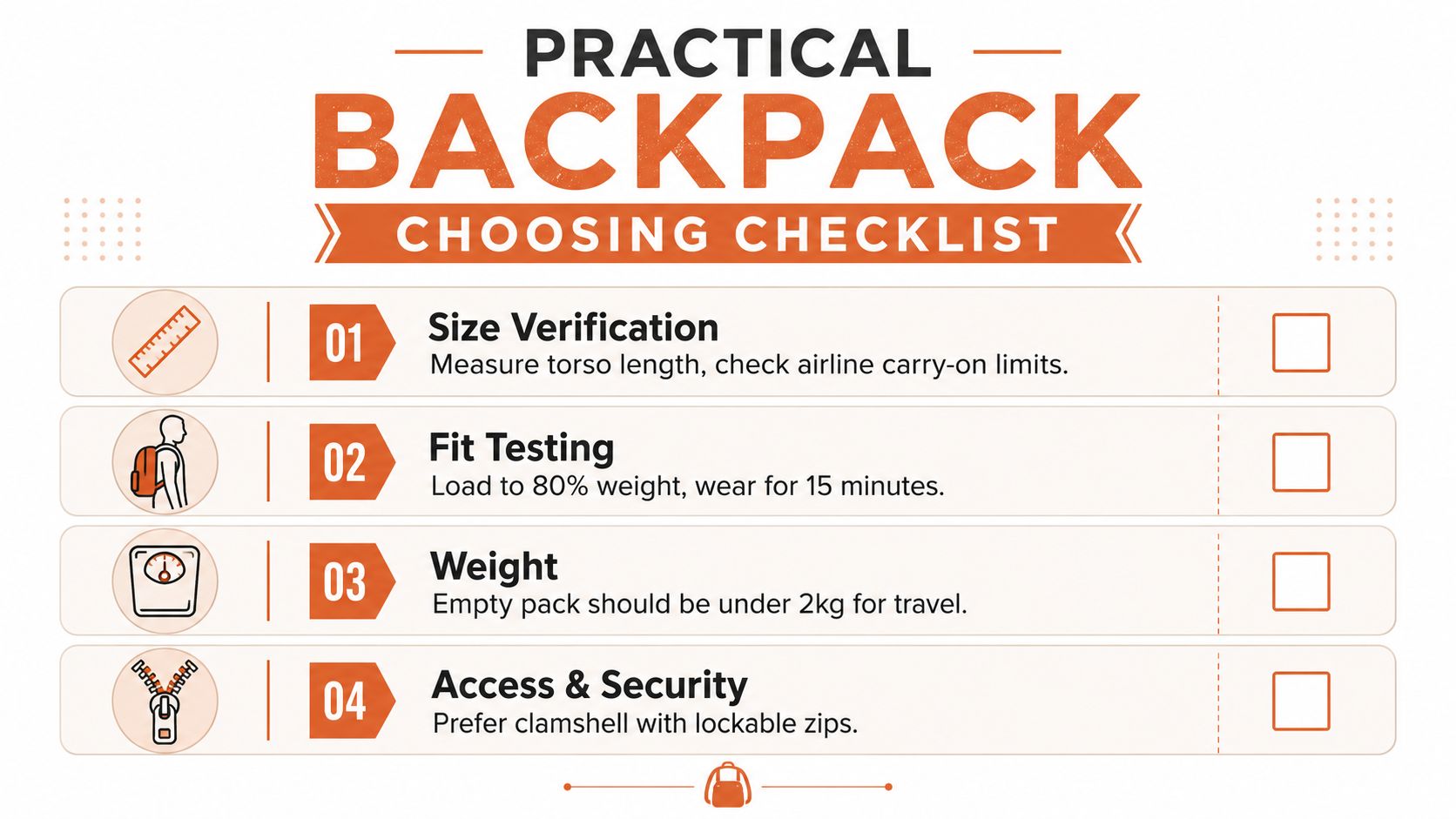
Check the actual measurements
Ignore the headline litre figure until you’ve checked height, width and depth. Compare the loaded shape with the strictest airline allowance on your route. A compression panel helps, but it won’t rescue a bag that’s too tall or deep.
Test the fit under realistic load
Put weight in the bag, place the heaviest items close to your spine and wear it while walking. Adjust the torso length, hip belt and sternum strap in that order. Look for a stable pelvis, relaxed shoulders and no pressure against your neck.
The supplied checklist visual suggests loading the pack to 80% and wearing it for 15 minutes, but treat those figures as a testing prompt rather than a guarantee for every body shape. An empty bag can feel excellent and fail once filled.
Keep the empty weight sensible
An unnecessarily heavy pack steals capacity before you’ve added clothing. For a cabin-focused travel pack, favour a strong but uncomplicated frame, useful padding and durable fabric over bulky trekking features you won’t use.
Inspect access and security
Open the main compartment fully. Check whether the laptop sleeve is protected, whether the zip pulls accept a small lock and whether the hip belt can be stowed if you need a cleaner airport profile. If you’re carrying boards or beach equipment, these backpack choices for surfers offer a useful reminder that specialised gear changes the ideal bag shape.
Finally, read the airline’s current baggage page before paying. For packing regrets and useful omissions, the backpacking essentials guide can help you avoid filling the bag with items that never leave it.
Putting It All Together for Your Next Trip
For a typical UK to Europe hostel route, I’d choose a well-fitted 40 litre clamshell backpack with a proper hip belt, lockable zips and compression straps. Pack light enough to keep its shape, measure it when full and build your airline choice into the route before booking flights.
That setup lets you walk from a station, keep both hands free and move between social city-centre hostels without dragging a case over cobbles. It also leaves more money and energy for neighbourhoods, museums, local food and conversations in the communal spaces where solo trips become memorable.
Don’t buy the biggest bag you can carry. Buy the smallest one that carries your real kit comfortably and remains legal for the flights you intend to take.
St Christopher’s offers central hostels across cities including London, Paris, Berlin, Amsterdam, Barcelona and Bruges, with clean dorms and private rooms, secure storage, social spaces and lively on-site bars where travellers and locals mix. Visit St Christopher’s to find a practical base for your next backpacking route and book direct for travel-friendly benefits including a welcome drink, free cancellation options and 25% off food at the bars during your stay.
Our direct rates are guaranteed to be at least 5% cheaper than anywhere else online, with a free drink on arrival, 25% off food at the bar, and free cancellation options available.