You’ve arrived in Paris alone, dropped your bag at reception, and now you’re standing outside wondering whether to queue for...
Share This Article
You’ve arrived in Paris alone, dropped your bag at reception, and now you’re standing outside wondering whether to queue for dinner, master the Metro, or just walk until the nerves settle. That slightly awkward first hour is normal. Paris for solo travellers works best when you stop treating the city as a romantic backdrop and start using it as a practical, walkable place built around cafés, museums, neighbourhoods, public transport and people constantly coming and going.
The trick is to plan enough to feel secure, then leave room for the unplanned moments. Eat at a busy counter, take a long walk beside the Canal Saint-Martin, ask for directions in your best French, and choose accommodation that gives you a social option when you want conversation. Here’s how to make the city comfortable, affordable and rewarding on your own.
Why Paris is the Ideal Solo Destination
Your first hour in Paris alone can feel oddly exposed. You leave the station checking directions, approach a café table for one, and wonder whether everyone notices. They do not. Parisians read, work, eat and walk alone every day, so solo travel quickly becomes ordinary rather than theatrical.
Paris also suits budget-conscious travellers from the UK because the route is familiar and the visitor infrastructure is extensive. Residents of Great Britain made 9.1 million visits to France in 2024, making France the second most visited country after Spain, according to UK travel trends data. Regular connections, established tourist districts and widespread understanding of English make the first trip easier to organise.
The city’s scale gives you options without forcing constant spending. The Paris Region welcomed 48.7 million tourists in 2024, including 22.6 million international tourists and 26.1 million French tourists, according to the official Paris Region tourism review. You can build a day around one paid attraction, then fill the rest with neighbourhood walks, markets, churches, parks and café stops.
A city with a familiar visitor rhythm
British travel to Paris has a long track record. Historical data records stays by British tourists from 2007 to 2019, while regional figures show arrivals reached 48.7 million in 2024, up 2% from 2023, and international arrivals reached 22.6 million, up 3% year on year, as reported in the historical Paris tourism data.
That steady flow reduces social friction. Staff are used to visitors, museums provide easy solo activities, and busy cafés make eating alone feel normal. Choose a counter seat or a small table, order at your own pace, and bring a book if you want a natural pause between sights. For transport, check the fare zone before committing to a distant hotel or day trip. A cheaper room outside the centre can lose its value if every journey adds time and ticket costs.
Paris also gives you plenty of low-pressure ways to meet people. Join a walking tour, stay somewhere with a common room, or ask a bartender about a neighbourhood event. For destination ideas suited to independent older travellers, senior travel destinations 2026 offers a useful wider perspective. St Christopher’s guide to the best cities for solo female travel in Europe is useful when comparing social settings before booking.
A useful mindset: Choose one major sight, one neighbourhood and one unplanned stretch each day. Paris rewards flexibility more than an overloaded schedule.
Navigating Paris Safely on Your Own
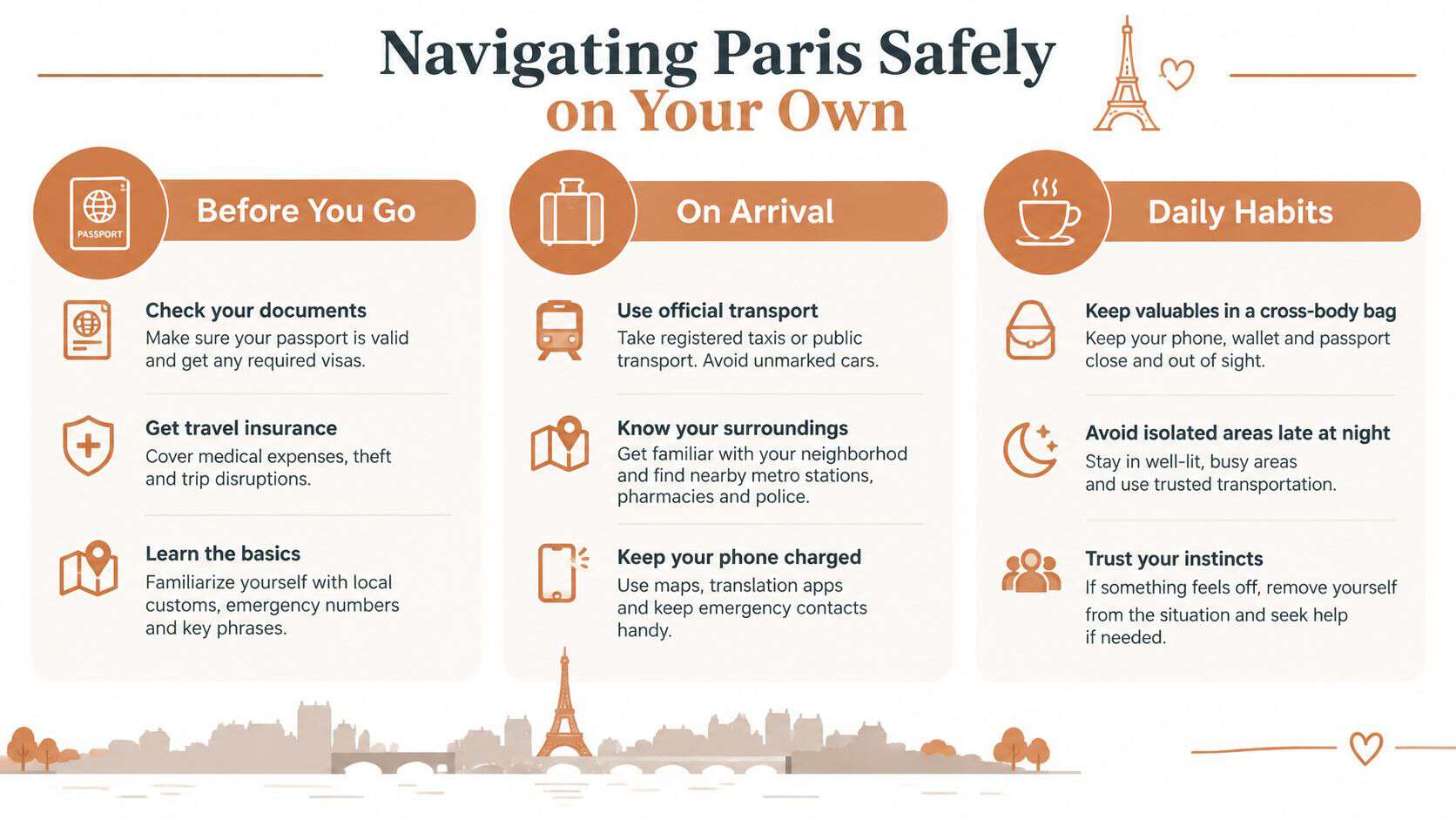
Paris requires normal big-city awareness, not constant alarm. The practical risk for a solo visitor is mainly opportunistic theft, particularly when crowds, queues, public transport and distracted sightseeing create easy opportunities. Your aim is to make yourself an inconvenient target and keep your essentials recoverable if something does go wrong.
The UK Foreign Office guidance referenced in current travel discussions recommends separating your passport and cards, using inside compartments, carrying a bag across your body, keeping belongings close in cafés and bars, and never leaving valuables unattended in a vehicle. Those habits matter most around crowded tourist areas, stations and ATMs, where you’re likely to be focused on signs, tickets or your phone.
Small habits that make a big difference
Keep your main card and passport in separate places. Carry only what you need for the day, and put your phone away before you enter a busy Metro carriage. In a restaurant, keep your bag between your feet or loop its strap around your leg rather than hanging it over the back of a chair.
At an ATM, check the machine and the people around you before withdrawing cash. Don’t let a stranger rush you, distract you or offer unsolicited help. If something feels staged, cancel the transaction and move on.
Late travel deserves a simple decision rule. Use well-lit, populated routes, avoid wandering through unfamiliar quiet streets while absorbed in your phone, and choose an official taxi or a trusted ride service if you’re exhausted after a late arrival. For an evening out, stick to lively streets and leave with enough phone battery for directions and emergency contact.
You don’t need to avoid Paris after dark. You do need to notice how the environment changes between a busy boulevard and an empty side street. Solo travel removes the second pair of eyes that might notice a bag being opened, so compensate with deliberate habits rather than fear.
Practical rule: Keep your valuables close enough that another person can’t reach them without you noticing.
For a deeper look at accommodation security and the questions solo women often ask before booking, read this guide on whether hostels are safe for solo female travellers. The same principles apply anywhere you stay, secure entry, a staffed reception and a clear plan for getting back at night.
Choosing the Right Neighbourhood and Accommodation
Where you stay decides whether Paris feels effortless or like a daily commute. The 1st and 2nd arrondissements put you close to the Louvre, the Seine and historic central streets. The 4th, especially Le Marais, is lively, walkable and strong for food, shopping and people-watching. The 5th and 6th suit travellers who want bookshops, cafés, the Latin Quarter and an easy walking culture.
For better value without giving up central access, look towards the 9th and 10th arrondissements. Canal Saint-Martin gives you a more local evening atmosphere, while the surrounding Metro connections make it straightforward to reach the major sights. The right choice depends on whether you value immediate sightseeing, neighbourhood character or a social base.
Hotel privacy versus hostel connection
A private hotel room gives you quiet and personal space, but it can leave the hardest solo-travel question unanswered: where do I go when I want company? You might spend the day exploring alone, return to a silent room and then face the effort of finding a welcoming venue from scratch.
A social hostel changes that rhythm. You can have a dorm or private room, use communal areas when you feel like talking, and retreat when you don’t. The on-site bar is the important part, not because you need to party every night, but because you’ve got an easy place to eat, have a drink and meet people without crossing the city alone.
For more detail on choosing an affordable central base, see this guide to Paris youth hostels. Book the accommodation that matches how you travel, not the one that looks impressive in a photograph.
Mastering the Transport Network and Day Trips
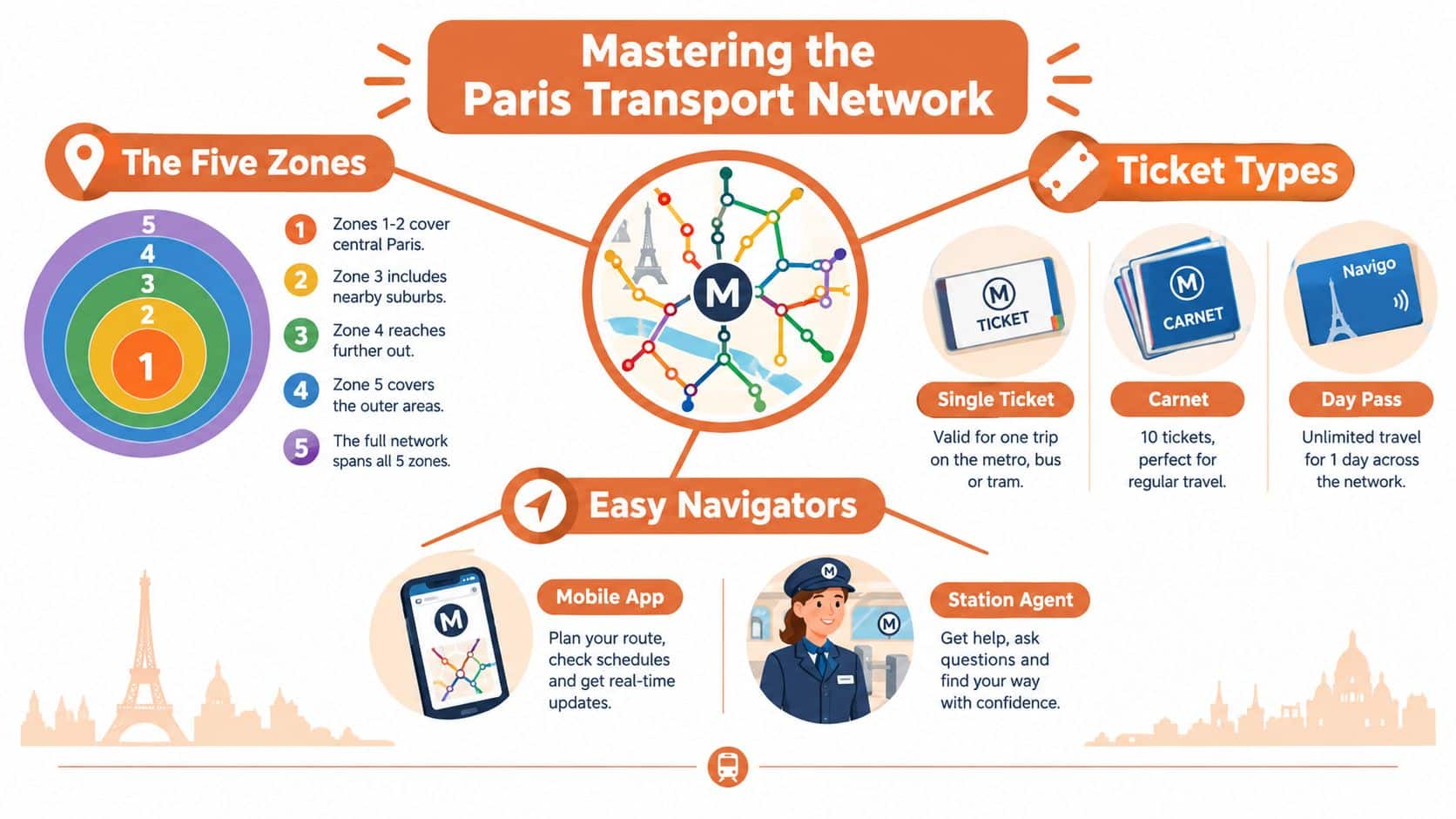
Paris transport becomes simple once you stop thinking of every journey as a separate ticket problem. The official network is organised into five fare zones, with zone 1 covering Paris intra-muros, zones 2 and 3 covering the inner suburbs, and zones 4 and 5 reaching farther across Île-de-France, as explained in this overview of Paris transport zones.
The central city is where most first-time sightseeing happens, so check the zones before you buy a pass for a day trip. Versailles and Disneyland Paris sit outside the central area, which means the ticket or pass that works for your ordinary Metro journeys may not cover the whole trip.
Use the integrated network intelligently
RATP’s official map shows the Metro, RER, bus and tram services as one connected network. That integration makes public transport the sensible default for solo visitors, especially when a taxi would add cost without necessarily saving much time.
Metro: Use it for fast movement around central Paris, then walk the final stretch.
RER: Choose it for longer regional journeys, including major day-trip routes.
Bus: Pick buses when you want to see the city above ground instead of disappearing into tunnels.
Tram: Use the outer network when your destination sits beyond the central Metro pattern.
Download the RATP app before leaving your accommodation, check the final station or direction on the platform signs and allow a little time for transfers. Keep your phone secure while checking routes in crowded stations.
Versailles makes an excellent first day trip because the palace, gardens and regional transport create a clear full-day plan. Disneyland Paris is another straightforward choice if it matches your interests, but check the destination zone before travelling rather than assuming a central ticket will be valid.
If your timing is flexible, compare travel dates and broader planning considerations with this guide to Europe flight cost timing from INVOLUNTARY REROUTE. The same principle applies to rail travel from the UK, book around the overall trip rather than looking at accommodation in isolation.
Budget Hacks and Solo Dining Without the Awkwardness
Dining alone in Paris is less uncomfortable when you choose the right format. A quiet, formal dining room can make you feel observed, while a busy brasserie, bakery counter, food market or wine bar gives you something to do and enough background noise to disappear comfortably into the room.
Start with lunch when you want a proper sit-down meal. Look for a daily menu near offices or residential streets, ask for a table for one without overexplaining and take the seat at the counter if that’s available. For dinner, choose a lively neighbourhood bistro, eat at the bar or pick up a picnic from a market and settle beside the Seine or in a park where permitted.
Make one person feel like the intended audience
Reservations help, even for one. Ask for a counter seat or a small table, and mention that you’re dining alone when you book. Staff can usually place you somewhere comfortable, and you won’t waste an evening walking between full restaurants.
Use cafés for a slower meal, crêpes or coffee, and save grand formal restaurants for occasions where the food matters more than speed. A book or notebook is useful, but don’t hide behind your phone for the entire meal. A brief “bonjour”, a question about the daily special and a polite “merci” make interactions feel natural.
Accommodation costs can also surprise first-time visitors if you ignore local charges. From 1 January 2026, the official French notice lists a total tourist tax of €15.93 per adult per night for palace accommodation, while three, four and five-star campsites pay €1.95, and one-star accommodation, holiday villages, bed and breakfasts and group inns pay €2.60, after the applicable additions. Check the category of your accommodation and include the tax in your planning using the official French tourist tax notice.
Socialising and Meeting People Organically
Solo travel doesn’t require you to schedule every social interaction. The best conversations usually happen where people already have a reason to pause, eat or wait, a communal table, a walking tour, a cooking class, a museum café or a busy bar.
Begin with low-pressure contact. Ask someone whether they’ve found a particular gallery, comment on a dish, offer to take a photograph or join a free walking tour where conversation has an obvious subject. Parks and museum courtyards work well during the day because people are already lingering rather than rushing towards the next attraction.
Choose spaces that do the introductions for you
A social hostel has a clear advantage over an isolated room when you’re travelling alone. You don’t have to manufacture a meet-up or rely on dating apps. Sit in a communal area, ask whether anyone is heading out for food and decide after a few minutes whether you want to join.
Try a simple evening pattern:
Have dinner in the on-site bar or a nearby café.
Join a group event or sit in a shared area for one drink.
Ask one open question, such as where someone has explored that day.
Leave while the evening still feels enjoyable, rather than waiting for the group to disperse.
You can still spend most of the day alone. That balance is the point. Paris gives you solitude on demand, while a well-run social base gives you company without forcing it.
Flexible Itineraries for One to Five Days
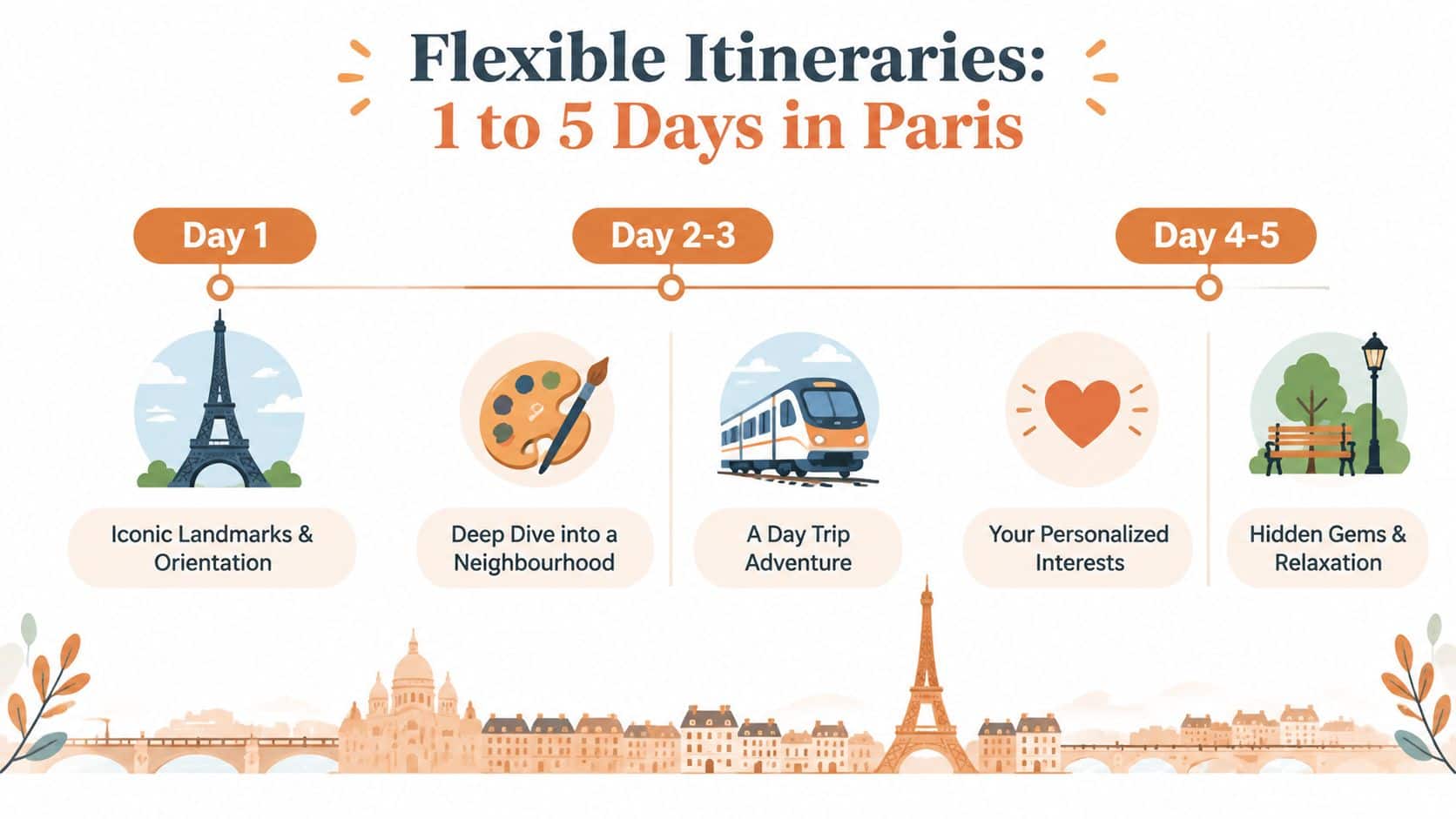
The best Paris itinerary has anchors, not a rigid timetable. Choose one major attraction each day, group nearby neighbourhoods together and keep an unplanned period for food, wandering or rest. You’ll enjoy the city more than if you spend every hour crossing it.
For one day
Stay central and keep the route compact. Walk along the Seine, choose either the Louvre or the Musée d’Orsay, then continue through the Tuileries or towards Saint-Germain. Have lunch at a café or market counter, and spend the evening in a busy neighbourhood venue where sitting alone feels ordinary.
Don’t add Versailles to a single-day visit. The journey and scale of the site deserve more breathing room.
For two or three days
Use the first day for orientation and an iconic sight. The Eiffel Tower, the Seine and a relaxed meal give you a clear sense of the city without exhausting you.
On the second day, explore Le Marais, including Place des Vosges, its food streets and independent shops. If you’ve got a third day, choose Montmartre in daylight, walk up towards Sacré-Cœur and eat away from the busiest square. Finish with a social drink rather than another major attraction.
For four or five days
Add a full day trip, checking the relevant fare zones before you travel. Versailles is the obvious choice for royal history, while Disneyland Paris suits visitors who want a dedicated theme-park day. Pack food from a market if you’re trying to keep the outing affordable.
Use the remaining time for a slower neighbourhood day. Explore the Latin Quarter and Saint-Germain, browse bookshops, sit in the Jardin du Luxembourg or follow the Canal Saint-Martin. Leave one evening deliberately open for a shared meal, an event or a conversation that began back at your accommodation.
A useful five-day rhythm looks like this:
Day one: Arrival, orientation, the Seine and one central landmark.
Day two: Louvre or Musée d’Orsay, followed by a gentle walk.
Day three: Le Marais or Montmartre, with a neighbourhood dinner.
Day four: Versailles or another planned day trip.
Day five: Markets, cafés, shopping and time to revisit your favourite area.
You don’t need to see every famous building to have a memorable trip. You need a safe base, transport you understand, meals that don’t strain your budget and enough social flexibility to enjoy Paris on your own terms.
St Christopher’s offers central Paris bases at Gare du Nord and Canal, with clean rooms, communal spaces and Belushi’s bars where solo travellers can eat and meet people without making a separate evening plan. Visit St Christopher’s to explore the Paris locations and book direct with the available welcome drink, flexible cancellation and food benefits.
Our direct rates are guaranteed to be at least 5% cheaper than anywhere else online, with a free drink on arrival, 25% off food at the bar, and free cancellation options available.