How to Spend Two Days in Amsterdam: A Smart Itinerary
Sophie
Two days is enough to see Amsterdam’s core, and the most efficient version is a Museumplein and canal belt day...
Share This Article
Two days is enough to see Amsterdam’s core, and the most efficient version is a Museumplein and canal belt day followed by a Jordaan, De Pijp, or Noord day. Book your timed entries first, then build the route around them rather than trying to squeeze every famous sight into a loose walking list.
You’ve probably just landed at Schiphol, checked your train platform, and opened six tabs covering the Anne Frank House, Rijksmuseum, Van Gogh Museum and canal cruises. That’s the point where many short breaks go wrong. Amsterdam looks compact enough to improvise, but its headline attractions run on timed entry, and one missed booking can turn a carefully imagined weekend into queues, backtracking and hurried meals.
|The useful mindset is simple: book in priority order, stay central, and keep each day inside one mobility zone. Amsterdam’s local tourism figures show almost 10 million overnight visitors in 2024, generating nearly 23 million overnight stays, with the average stay lasting 2.36 nights. That’s a city built around short breaks, so this route is designed for a realistic 48 hours, not an exhausting checklist. (Amsterdam’s tourism statistics)
Why Two Days in Amsterdam Feels Different From Other City Breaks
Stepping off the train at Amsterdam Centraal gives you an immediate advantage. You’re already beside the historic centre, with the canal belt spreading south and the city’s main districts connected by foot, tram and ferry. With two days ahead, the temptation is to walk out with no plan and let the city reveal itself.
That works in some European capitals. Amsterdam is different because the city’s most important experiences don’t always reward spontaneity. Anne Frank House, Van Gogh Museum and Rijksmuseum visits depend on timed slots, while the compact central streets attract intense day and overnight traffic. A route that looks short on a map can become slow once you add queues, crowded bridges, bicycle lanes and a wrong turn along the canals.
Your first decision is the booking order
Start with the attraction that gives you the least flexibility, usually the Anne Frank House. Then secure one Museumplein anchor, either the Van Gogh Museum or Rijksmuseum, before choosing the cruise and filling in meals and neighbourhood walks.
Practical rule: Treat every fixed ticket as an immovable point on the map. Everything else can move around it.
Cluster the city instead of crossing it
Day 1 works best as Museumplein, the canal belt and the Nine Streets. Day 2 should stay in Jordaan, De Pijp or Noord, not bounce between all three. This approach makes the city feel calmer because you’re walking between nearby stops rather than spending your limited daylight crossing Amsterdam to recover from an overambitious itinerary.
The railway connection helps too. Schiphol to Centraal takes about 14 minutes, making it realistic to start exploring on arrival day if your bags and check-in allow it. (Two-day Amsterdam routing guide)
What the Visitor Numbers Tell You About Planning a 48-Hour Trip
Amsterdam’s demand explains why a casual plan falls apart. The city recorded nearly 23 million overnight stays in 2024, and more than 80% of tourist overnight stays were made by foreign visitors. UK travellers are among the city’s key source markets, so you’re sharing the same central attractions with a large international short-break audience. (Amsterdam tourism figures)
The centre also serves a huge day-trip audience. Amsterdam logged around 14 million day visitors in 2024, close to 27 million total day visits, alongside about 0.5 million cruise passengers. The result is predictable. Walk-up capacity disappears quickly at the places everyone recognises, particularly around Museumplein and the canal belt. (Dutch tourism reporting on Amsterdam demand)
The attraction queue problem
Timed entry is not a minor convenience. It decides whether your day has shape. The Anne Frank House and major museums use reserved slots, so book them before you start arranging coffee stops, canal walks or dinner. A missed slot can’t be fixed by turning up later.
I won’t invent a queue estimate where the official information doesn’t provide one. The useful conclusion is stronger than a made-up waiting time: walk-up access is too uncertain for a 48-hour trip. If an attraction matters to you, reserve it and let the rest of the route flex around it.
Attraction
Typical booking lead time
Walk-up wait on a peak weekend
Timed entry required
Anne Frank House
Book as soon as your dates open
Unpredictable, and a dmission may not be available
Yes
Van Gogh Museum
Reserve before travelling
Availability varies by date
Yes
Rijksmuseum
Reserve before travelling
Availability varies by date
Entry time required
Canal cruise
Reserve your preferred evening
Depends on departure and demand
Usually tied to a departure
Amsterdam's policy sets a 20 million visitor annual cap, combining overnight stays and day visits. That policy context matters because the city is actively trying to manage pressure through tourism controls, not waiting for the centre to become quieter by itself. (Amsterdam tourism policy)
The smart response isn't to avoid Amsterdam's famous sights. It's to reserve them in the right order, visit early where possible and spend part of the trip in neighbourhoods that give you more room to wander.
Day 1 Itinerary Through Museumplein and the Canal Belt
Make Day 1 a south-to-north arc. Start with one serious museum, move through Vondelpark and the Spiegelstraat quarter, then let the canal belt carry you back towards Centraal. This keeps the day visually varied without sending you across the city.
Morning in Museumplein
Book the Rijksmuseum or Van Gogh Museum for the first useful morning slot you can secure. Don't book both back to back. One museum gives you enough to absorb, while two can turn the day into a blur of galleries and tired feet.
If you choose the Rijksmuseum, focus on the major Dutch masters and the Gallery of Honour rather than trying to inspect every room. If you choose Van Gogh, give yourself time to look closely at the paintings and follow the development of his work instead of rushing through for a few famous images.
Afterwards, walk towards Van Baerlestraat for coffee. You're close to the museums, but the pause changes the rhythm before the next stretch. If the weather is reasonable, continue through Vondelpark, using the park as a slower route rather than treating it as another attraction to tick off.
Afternoon along the canals
Cut back towards the Spiegelstraat quarter for lunch, then head north-west into the canal belt. Aim for the triangle formed by Singel, Herengracht and Keizersgracht. Amsterdam starts to look like the city from the postcards here, but the best experience comes from walking a few streets beyond the busiest photo stops.
Pause at a traditional brown café near Leidsestraat in the middle of the afternoon. Keep the stop short enough to protect your cruise booking, then make your way to a central jetty for a late-afternoon or early-evening canal departure. A cruise gives you a different view of the narrow houses and bridges, but one is enough for a two-day trip.
Evening in the Nine Streets
Finish with the Nine Streets, walking between the canals and small independent shops before dinner. The area is close enough to Centraal for an easy end to the day, especially if your base is nearby.
Don't measure Day 1 by the number of attractions. Measure it by whether you finish with energy for dinner.
Amsterdam's guided-tour rules allow tours in the centre to start from 8am and finish by 10pm, so check those limits if you add a walking, bike or evening tour. (Amsterdam guided-tour rules) If you're staying near Centraal, end the evening there rather than adding a long final tram journey. Day 2 will be better for it.
Day 2 Itinerary Through Jordaan, De Pijp, or Noord
Day 2 needs one clear choice. Pick Jordaan for atmosphere, De Pijp for food and local energy, or Noord for a more modern, spacious feel. Trying to combine all three usually means spending the day waiting for transport instead of enjoying the district you're in.
Choose Jordaan for a slow morning
Start near Westerkerk, then walk through Jordaan towards the Nine Streets for coffee. Continue along Prinsengracht, where the canal-side route keeps you close to the Anne Frank House area. If you secured a ticket, make this your fixed morning visit. If not, don't build your day around an uncertain queue.
For a deeper neighbourhood route, use this Jordaan travel guide to choose quieter lanes, cafés and canal stretches before lunch. Jordaan suits solo travellers particularly well because you can explore at your own pace without needing a packed schedule.
Choose De Pijp for food
Take tram 4 or 16 towards De Pijp and reach Albert Cuypmarkt before 11am, when browsing feels easier. Try a fresh market snack, then walk to Sarphatipark for a slower lunch, perhaps a simple broodje from a nearby café.
Use the afternoon for the Heineken Experience or House of Bols if either appeals to you. Don't add both unless you're happy to make Day 2 heavily indoor and attraction-led. De Pijp is better when you leave room for side streets, small shops and an unplanned drink.
Choose Noord for space
For a quieter, more contemporary day, take ferry 901 from behind Centraal to NDSM-Noord. Walk along the harbour, explore the industrial setting and stop for lunch in one of the waterfront hangars. The ferry ride gives you a change of scale without needing a long journey.
Whichever district you choose, end there. Have a drink at sunset and eat nearby instead of racing back through Centraal for one final central sight. The point of Day 2 is not to repeat Day 1 at speed. It's to let Amsterdam feel like a city rather than a collection of ticketed rooms.
Getting Around Amsterdam Without Wasting Your Two Days
Inside the canal ring, walking usually beats public transport. If a destination is under 15 minutes away on foot, walk it. You'll avoid waiting, see more of the side streets and won't lose time finding the correct platform.
Use trams for longer central hops. Trams 4, 14 and 16 are useful tourist routes, while the metro matters more when you're heading towards Noord or the RAI area. The ferry to Noord is a separate kind of journey, and it's worth taking when Noord is your chosen district rather than using it as a random detour.
Choose transport by the day you've planned
Option
Best for
Approx. cost for 48 hours
Pay-off rule
Walking
Canal belt, Jordaan and the Nine Streets
No separate fare
Walk short hops and save time
GVB public transport
Museumplein, De Pijp and longer connections
Check the current fare before travel
Choose it when several tram journeys are unavoidable
I amsterdam City Card
Packed museum itineraries
€94 for 48 hours
Consider it when you’ll use the included museums and cruise
Canal cruise
Seeing the city from the water
Varies by operator
Book one cruise, not several
The I Amsterdam City Card 48-hour option costs €94 and includes unlimited GVB public transport, entry to 70+ museums and one free canal cruise. It makes sense for a museum-heavy itinerary, not automatically for every visitor. (I Amsterdam City Card details)
If you activate the card at 2pm, it runs until 2pm two days later. That can work well if your arrival afternoon includes a museum and your departure day still has useful sightseeing time. (City Card activation guidance)
If you’re skipping most paid museums, use a regular GVB ticket or contactless payment for the journeys you make. For cycling ideas beyond the centre, keep this guide to Amsterdam cycle routes for a longer visit rather than forcing a bike ride into an already tight itinerary.
What to Book Before You Fly and In What Order
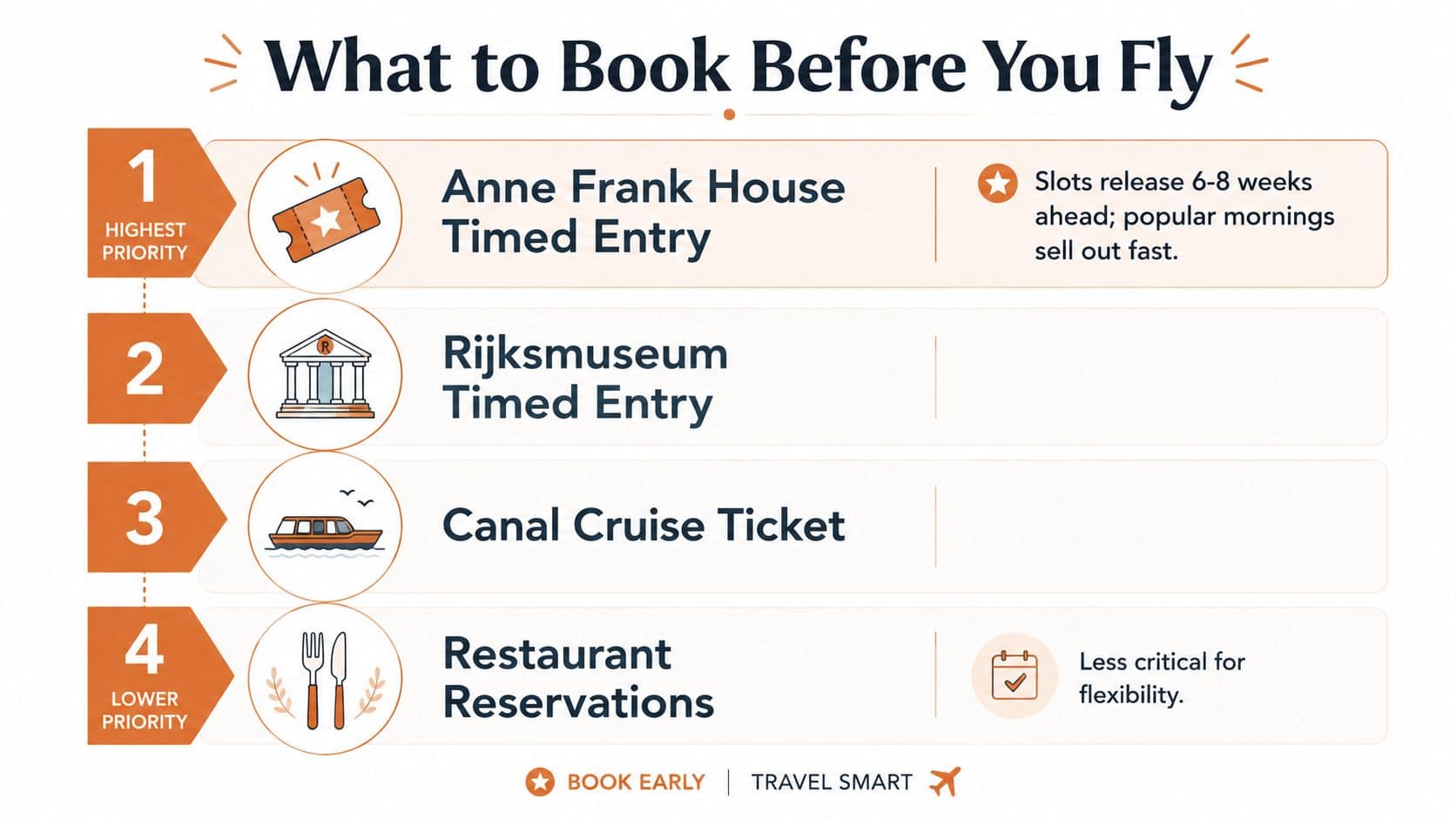
Book in this order. The first item has the least flexibility, and the last should remain adjustable until you know your energy, weather and arrival time.
Anne Frank House first. Secure the timed entry as soon as your dates become available. It’s the booking most likely to dictate the shape of Day 2.
Van Gogh Museum or Rijksmuseum next. Pick one for Day 1 morning and reserve its entry time. Don’t build a museum double-header unless both are essential to you.
Canal cruise after the museum. Choose a late-afternoon or evening departure close to your Day 1 route, not one that sends you back across the city.
Transport after the attractions. Compare a GVB ticket, an Amsterdam and Region Travel Ticket and the I Amsterdam City Card against the actual route you’ve planned.
Restaurants last. Reserve any dinner you care about, particularly for Saturday or De Pijp, but keep lunch flexible. Solo travellers often eat better by choosing a busy neighbourhood spot once they know where the day has taken them.
Keep the admin simple
Save every confirmation and QR code offline before leaving for the airport. You don’t want to depend on a patchy connection at Schiphol or Centraal while a timed entry window approaches.
Pack snacks that travel well if you know you’ll be moving between museums and neighbourhoods. These business travel eating tips are aimed at work trips, but the practical advice also helps on a compressed city break when a proper meal doesn’t fit neatly between bookings.
Skip pre-booking the Heineken Experience unless it’s central to your Day 2 plan. It can fill a gap, but it shouldn’t control the whole itinerary.
Where to Base Yourself to Make the Itinerary Work
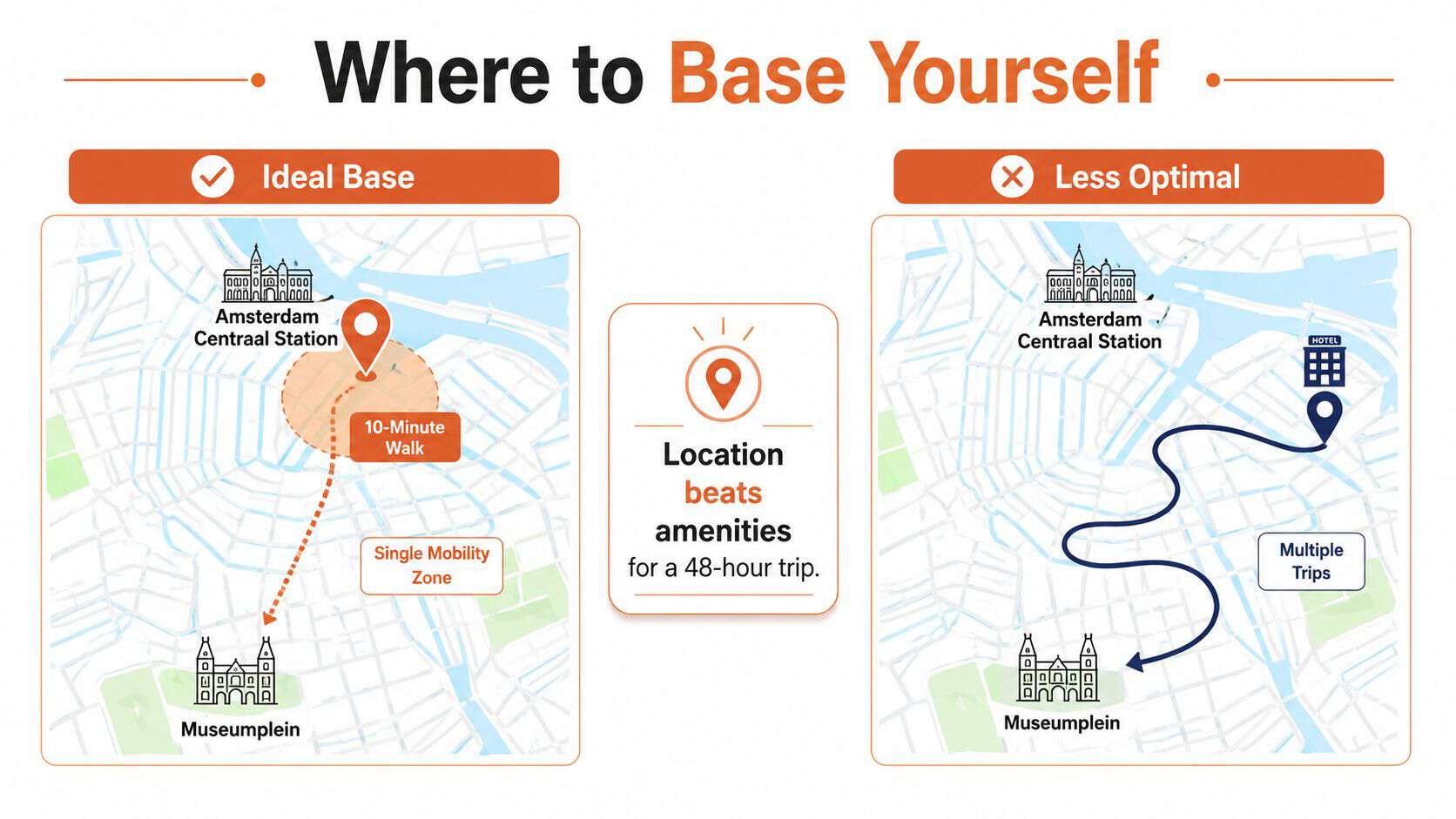
For a 48-hour Amsterdam trip, location beats amenities. A base within a short walk of Centraal or the canal belt means you can start quickly, return briefly when needed and finish both evenings without wasting your remaining energy on transport.
A stay close to Centraal keeps the two routes connected. Museumplein is one tram hop or a longer canal-side walk away, while Jordaan begins close to the station and De Pijp is straightforward by tram. You’re not paying only for a bed. You’re protecting the time that makes the itinerary possible.
The trade-off with staying further out
Bijlmer and Sloterdijk can offer lower rates, but the cheaper room comes with a daily commute and a transfer. On a short break, that exchange is rarely worth it unless the saving is substantial and your plans are already light.
A central budget base can also reduce incidental transport spending. It gives you flexibility. If a museum overruns, you can still reach dinner. If you find a canal route you love, you don’t have to abandon it because your return journey is long.
The central base I’d choose
The Winston sits in the Centraal-to-canal sweet spot, so it works naturally with the route above. It gives solo travellers a central base, social spaces and an on-site bar, which means you don’t have to leave the hostel to find a place where travellers and locals can mix.
For more accommodation context, see this guide to the best hostels in Amsterdam. Book direct where possible and check the cancellation terms carefully, particularly if your attraction tickets are still being released.
The calculation is straightforward. A central base isn’t about adding luxury to a short trip. It’s about removing friction from every morning and evening, so the bookings you secured fit the days you have.
Making the Second Day Count When Things Don’t Go to Plan
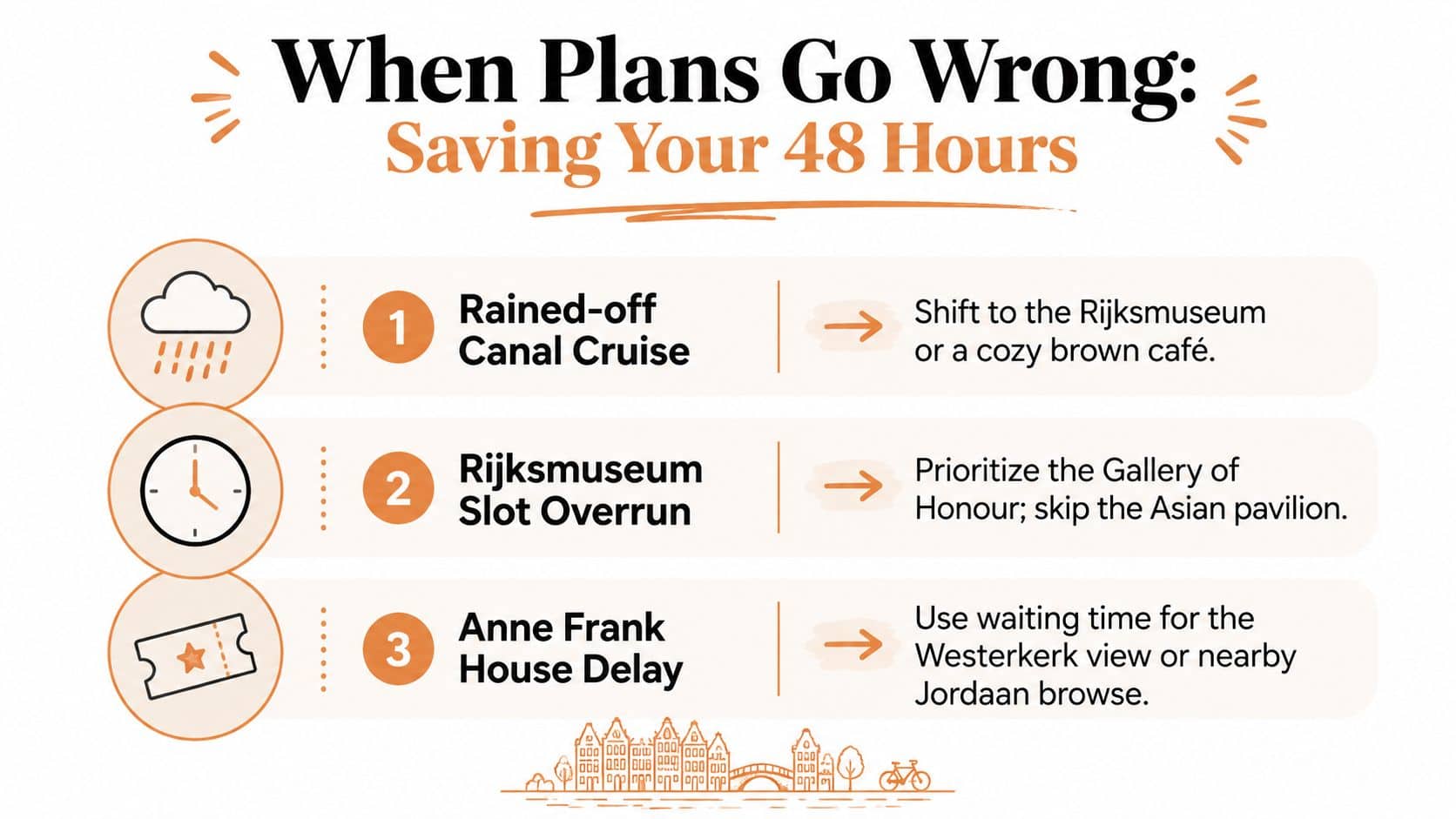
Something will slip. A cruise may be rained off, a museum visit may run long, or the Anne Frank House may be unavailable when you try to book. The solution isn’t to rebuild the entire weekend. Keep one indoor anchor and one outdoor anchor in reserve.
If the cruise is rained off
Move indoors without crossing town. Visit the Rijksmuseum if you haven’t already, browse the covered Bloemenmarkt, or settle into a warm brown café in Jordaan. Keep the canal experience for a dry walk along Prinsengracht rather than forcing yourself onto the water in bad weather.
If the Rijksmuseum overruns
Don’t try to recover every room. Prioritise the Gallery of Honour, then leave the Asian pavilion and secondary galleries for another visit. Push lunch into De Pijp and use the extra time for Van Gogh only if you already have a valid timed entry. Otherwise, enjoy the neighbourhood instead of turning the afternoon into a sprint.
If you couldn’t get the Anne Frank House
Use the surrounding area well. Walk past Westerkerk, browse Jordaan and take your time along the nearby canals. If you want another museum with historical depth, the Resistance Museum is a strong alternative, but only choose it if the route fits your energy.
Keep slack in the morning, not the evening. A late dinner is easier to move than a missed timed entry.
Amsterdam’s visitor pressure is real, and the city’s tourism policy shows why the busiest central sights won’t reliably accommodate last-minute plans. But a flexible structure still works. Keep one indoor anchor, such as the Rijksmuseum, Stedelijk or a long lunch, and one outdoor anchor, such as a canal walk, Vondelpark or the Noord ferry. Swap between them when the weather or queues change, and your 48 hours will still feel deliberate.
St Christopher’s offers The Winston in Amsterdam’s city centre, with a social atmosphere, safe and clean facilities, and an on-site bar where you can meet other travellers without heading across town. Visit St Christopher’s to check the Amsterdam base and book direct with benefits such as a welcome drink and 25% off food at the bar.
Our direct rates are guaranteed to be at least 5% cheaper than anywhere else online, with a free drink on arrival, 25% off food at the bar, and free cancellation options available.