10 Instagrammable Spots in Barcelona: Photo Tips and Routes
Sophie
It’s early in Eixample, you’ve got a coffee in one hand and your phone in the other, and the light...
Share This Article
It’s early in Eixample, you’ve got a coffee in one hand and your phone in the other, and the light is catching the tiles on a Gaudí façade. Then you check your saved posts. There’s a basilica, a mosaic terrace, a rooftop and a beach, all apparently essential, with no clue which ones need tickets or belong on the same walk.
The best Instagrammable spots in Barcelona aren’t necessarily the ones you should pay to enter. Some work beautifully from the pavement. Others justify admission because the photograph you want isn’t available outside.
These ten stops separate free exterior photographs from paid visits, with practical advice on light, crowds and where to stand. You’ll also find walking combinations that make more sense than crossing the city whenever another saved post catches your eye.
Before booking attractions, compare total travel costs and decide which interior matters most to you. Keep room in your budget for food, transport and an unplanned stop rather than buying admission everywhere.
For architecture: Pair Casa Batlló and Casa Milà, or Sagrada Família and Sant Pau.
For a largely free walk: Link the Gothic Quarter, the Kiss Mural and Parc de la Ciutadella.
For changing light: Treat Barceloneta sunrise and Montjuïc late afternoon as separate outings, not obligations in an exhausting marathon.
1. Sagrada Família and Plaça de Gaudí
Start across the pond in Plaça de Gaudí, where trees and water give the Nativity façade a natural frame. You don’t need an admission ticket for this exterior composition, although you do need patience if others reach the same viewpoint.
For the reflection, timing beats gear. Early and late both give low, warm light, but the shot depends on still water. Shoot low from the water’s edge so the basilica doubles in the frame.
Early arrival thins the crowd without promising an empty park. Photograph the pond, then circle the basilica rather than leaving with the familiar view alone. If someone’s already posing in your spot, crop tighter through the trees instead of queuing.
Free façade or paid interior?
The exterior gives you scale and sculptural detail. A paid interior visit is the choice for stained glass and soaring columns, with afternoon sunshine potentially bringing warm colour through the western windows, depending on season and cloud cover.
The clip below is a quick way to scout angles around the basilica before you visit.
2. Park Güell
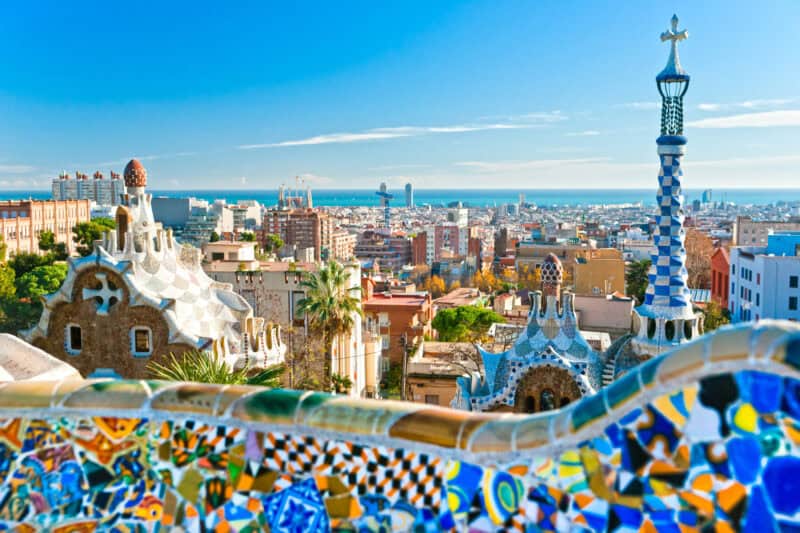
Book Park Güell for the mosaics and architecture, not just the skyline. Haze can flatten a distant city view, while the serpentine bench, Hypostyle Room and stone viaducts still offer strong shapes and textures.
Treat the signature terrace and salamander photographs as ticketed shots, rather than assuming an early arrival gets you free access. Choose an early available admission slot and leave enough breathing room to explore beyond the busiest staircase.
Before travelling: The official ticketing FAQs allow booking up to three months ahead and confirm that tickets are personal, nominative and non-transferable. Check the name and date, then keep your mobile QR code ready.
Getting uphill: Lesseps or Vallcarca can be useful approaches, but don’t mistake a metro arrival for reaching the entrance. Use the guide to getting around Barcelona and check the park’s current entrance guidance.
When the terrace fills: Photograph mosaic fragments or use the viaducts for portraits. Diffused light can be more forgiving here than strong sunshine.
You can get a satisfying Casa Batlló photograph without buying a ticket. Stand on the opposite pavement along Passeig de Gràcia, check what’s behind you, and frame the shimmering façade with its mask-like balconies.
A normal or modest wide-angle setting usually gives more natural architectural lines than an extreme ultra-wide view. If you can’t fit everything in safely, photograph a section rather than stepping into traffic or a cycle lane.
What admission adds
A paid visit changes the subject completely. Instead of a street façade, you’re photographing flowing staircases, the blue lightwell and sculptural rooftop details, subject to the spaces included in your chosen experience.
Casa Batlló’s visitor FAQs permit personal photography without a tripod and list general visits from 9:00 am to 7:15 pm, although particular dates and experiences can differ. Check the actual inclusions before paying for extras.
Budget call: Choose Casa Batlló if interior colour and flowing architectural details are what you most want to photograph. Don’t buy admission just because you feel the free façade shot isn’t enough.
For the exterior, compare the building’s bright and shaded areas before taking your portrait. Mid-morning can work, but softer light isn’t guaranteed by the clock. On a clear day, avoid placing someone half in shadow and half in direct sun.
Continue towards Casa Milà rather than making a separate trip for it.
4. Casa Milà, La Pedrera
Casa Milà is the stop for stone, curves and sculptural shadows. Its rippling façade offers a different mood from Casa Batlló, so the buildings work well together even if you photograph both only from the street.
For a free photograph, look for a position that shows the façade turning around the corner. Include enough surrounding space to make the curve readable instead of filling every edge with stone.
The paid rooftop is a different proposition. Its chimneys and ventilation structures give you foreground subjects, which are often more interesting than another distant city panorama.
Before paying: Confirm that your selected visit includes rooftop access and check whether weather could affect entry.
In strong light: Look for shadows that describe the rooftop forms. For portraits, check faces carefully rather than assuming dramatic architectural light will also be flattering.
In busy areas: Keep stairs and narrow passages clear. Take the photograph, then move somewhere wider to review it.
Choose according to the photograph
If you’ve already paid for Casa Batlló, don’t feel obliged to add another admission. Casa Batlló favours colour and interiors; Casa Milà favours rooftop sculpture and open-air compositions.
For example, a solo traveller who wants a recognisable street portrait can keep this stop free. Someone fascinated by abstract shapes may get more value from the rooftop than from another elaborate interior.
5. Pont del Bisbe and the Gothic Quarter
The challenge at Pont del Bisbe isn’t finding the bridge. It’s photographing it without treating Carrer del Bisbe as a private studio.
Stand farther back and let the lane lead towards the stonework. That gives the photograph depth and makes it easier to include people naturally, rather than waiting indefinitely for an empty street.
This is a free street-level stop. Morning is a sensible choice for a clearer view, but keep voices low around neighbouring buildings and leave entrances unobstructed.
Work with the shade
Narrow lanes can produce a bright strip of sky above much darker stone. Tap your phone screen on the bridge and check that the highlights haven’t lost all detail before taking the shot.
If a portrait looks gloomy, move your subject towards softer light near an opening rather than trying to brighten a heavily shaded face afterwards. Don’t step backwards while looking through the camera without checking the pavement.
An interesting street photograph doesn’t require every other person to disappear. A passer-by can show scale, provided you’re not intruding on them.
Keep your phone secure between photographs, particularly around busy cathedral approaches. Continue towards the Kiss Mural, with time for architectural details along the way, rather than repeatedly returning to the bridge for another attempt.
6. The Kiss Mural, El Món Neix en Cada Besada
From a distance, the Kiss Mural reads as a single intimate image. Up close, the ceramic photographs become the subject, so change your distance before changing your camera settings.
Begin far enough back to show the overall kiss. Then move closer for a detail photograph that explains how the larger picture is assembled.
A free stop that needs consideration
There’s no interior ticket to buy for this street-facing artwork. The practical cost is waiting if visitors are taking portraits, which is why an early visit usually makes more sense than adding it during the busiest part of your Gothic Quarter walk.
For the full mural: Keep the camera level and check the edges before pressing the shutter.
For tile details: Watch for reflections on the ceramic surface. A small change of angle may help more than editing.
For a solo portrait: Ask another visitor for a quick photograph and show them the framing you want. Don’t leave your phone unattended while you pose.
Bright patches of sunlight can make the larger image harder to read, while even shade can suit both the artwork and a portrait. Check the actual conditions rather than waiting for a supposedly perfect hour.
If there’s a queue, take your detail shots without getting in the way, then decide whether the portrait is worth waiting for. Nearby residents and businesses shouldn’t have to work around a permanent photoshoot.
7. Recinte Modernista de Sant Pau
If you want colourful architecture without building your whole day around Gaudí, Sant Pau deserves consideration for your paid visit. Its decorated pavilions, domes, ceramics and garden paths offer varied compositions within the former hospital complex.
Don’t arrive expecting it to be empty. The better reason to choose it is the range of subjects, which lets you move away from a busy doorway and find another frame.
Pay for a place you’ll explore
Treat the gardens and pavilion photographs as part of a ticketed visit. A photograph from outside isn’t a substitute for access to the complex, so check the current visitor calendar and included spaces before committing.
Use paths as leading lines and doorways as frames. In hard sunshine, concentrate on shaded architectural details rather than forcing a wide photograph with bright paving and dark entrances.
Walking combination: Approach from Sagrada Família along Avinguda de Gaudí. It’s a more coherent architectural outing than crossing between unrelated landmarks.
Portrait choice: Look for a quiet position beside a path, not in the centre of a doorway people need to use.
Access planning: Confirm accessible entrances, lifts, toilets and the spaces open on your date directly with the venue.
For a mixed-ability group, don’t assume attractive garden photographs prove that the whole route is step-free. Allow time to enjoy the site rather than treating every pavilion as another backdrop to collect.
8. Parc de la Ciutadella and the Cascada Monumental
After stone façades and narrow lanes, Parc de la Ciutadella gives you a greener setting and a less formal kind of photograph. The Cascada Monumental is the main architectural subject, while shaded avenues can work better for relaxed solo portraits.
The park and exterior cascade compositions are free. Build your photograph around the structure, sculptures and surrounding planting rather than depending on flowing water.
Morning is a useful choice for quieter paths. Later afternoon can bring softer light, but trees create patches of shade, so look at where the light falls on your subject before choosing a background.
Keep the composition simple
For a wide view, straighten the camera and check whether the foreground adds anything. For a portrait, move close enough that the person remains the subject rather than becoming a tiny figure beneath the monument.
Solo-travel habit: Keep your bag beside you and within reach while setting up. Don’t put it behind a bench or wall just to keep it out of the photograph.
If you’re asking another visitor to help, frame the photograph first and explain where you’d like to stand. A simple request is easier to follow than a long set of camera instructions.
Continue towards Arc de Triomf for another free exterior photograph. This pairing works naturally after the Gothic Quarter and Kiss Mural, without committing your day to timed admission.
9. Montjuïc, MNAC Terraces and Palau Nacional
Go to the terraces around the Museu Nacional d’Art de Catalunya for space, symmetry and views towards Plaça d’Espanya. The Palau Nacional also gives you an architectural backdrop when the distant skyline looks hazy.
Separate public exterior viewpoints from ticketed museum access. You don’t need to buy gallery admission just to photograph the building from an accessible public terrace, but don’t assume every upper-level area belongs to the same free route.
Arrive before the light changes
Give yourself time to choose between a city-facing composition and a portrait with the palace behind you. Late-afternoon light can be rewarding, although cloud, season and your direction of view all affect the result.
For a skyline: Use a nearby architectural feature as foreground rather than filling the frame with distant buildings.
For a portrait: Ask a fellow visitor for help and keep your belongings within reach.
For the evening: Carry a light layer, check current access arrangements and don’t build the visit around a fountain show without confirming official updates.
The guide to sunset spots in Europe offers inspiration for planning around changing light. Here, the practical priority is your return route, especially if stairs, gradients or unreliable lift access could make the outing difficult.
10. Barceloneta Beach and Passeig Marítim
Barceloneta is worth a separate sunrise outing, not a rushed addition after an already full architecture day. Check the sunrise time for your date and choose whether you want open water, beach activity or the promenade as your subject.
The beach and promenade photographs are free. Staying on Passeig Marítim is the simplest choice if you’d rather avoid sand in your shoes or camera equipment.
Photograph the light, not just the beach
Facing towards the bright horizon can turn people into silhouettes. That can work deliberately, but if you want a recognisable portrait, turn your subject and check the light on their face.
As the sun climbs, watch for glare and hard shadows. An earlier photograph with gentle colour may be more useful than waiting for a brighter scene.
Keep equipment close: Never leave a phone, camera or bag unattended while swimming or posing.
Respect other beachgoers: Ask before including someone prominently in a close-up.
Leave nothing behind: Bring a reusable water bottle and take your rubbish away, including anything you’ve moved for the composition.
If you’re meeting other travellers later, the Barcelona beach bars guide can help you plan a separate social stop. Don’t feel you need to stay at the waterfront all day just because you got up early for it.
How the 10 Barcelona photo stops compare on cost, timing and access
Item
Entry cost
Best time to shoot
Nearest metro
Sagrada Família and Plaça de Gaudí
Square and exterior free; interior admission paid
Early morning
Sagrada Família, L2 and L5
Park Güell
Paid entry
Early entry slot
Lesseps or Vallcarca, L3
Casa Batlló
Exterior free; interior admission paid
No specific time stated
Passeig de Gràcia
Casa Milà, La Pedrera
Exterior free; rooftop admission paid
Avoid bright midday light
Diagonal, L3 and L5
Pont del Bisbe and the Gothic Quarter
Free
Early morning
Not specified
The Kiss Mural, El Món Neix en Cada Besada
Free
Early morning
Not specified
Recinte Modernista de Sant Pau
Paid entry
No specific time stated
Sant Pau | Dos de Maig, L5
Parc de la Ciutadella and the Cascada Monumental
Free
Morning or late afternoon
Arc de Triomf, L1; Ciutadella | Vila Olímpica, L4
Montjuïc: MNAC Terraces and Palau Nacional
Outdoor viewpoints free; museum admission paid
Before sunset
Espanya, L1 and L3
Barceloneta Beach and Passeig Marítim
Free
Sunrise
Barceloneta, L4
Turning Ten Stops Into One Good Photo Day
Choose a route, not a collection of disconnected pins. Start early at Sagrada Família if the basilica is your priority, then continue towards Sant Pau. Alternatively, begin at Pont del Bisbe, visit the Kiss Mural and walk onwards towards Parc de la Ciutadella.
Casa Batlló and Casa Milà belong together on an Eixample walk. Mid-morning can suit that pairing, but inspect the light when you arrive rather than assuming it’ll always be soft. Save Montjuïc for a deliberate late-afternoon outing and Barceloneta sunrise for another day.
Spend on the photograph you actually want
Keep a budget for a paid interior that interests you. Choose stained glass at Sagrada Família, colour and flowing rooms at Casa Batlló, rooftop sculpture at Casa Milà or a broader architectural wander at Sant Pau.
If your interests extend beyond a backpacking budget, you can also explore luxury experiences in Spain. Keep those plans separate from your everyday photo route so an optional experience doesn’t swallow the money you need for the rest of the trip.
Crowd-aware photography matters here. Reporting on Barcelona’s overtourism pressures provides important context for treating residential streets as neighbourhoods, not sets.
Keep moving: If a pavement is blocked, choose another angle instead of adding to the obstruction.
Respect boundaries: Don’t climb barriers, enter private spaces or move residents’ belongings for a cleaner frame.
Plan for comfort: Check surfaces, gradients, seating and toilets as carefully as admission times.
Make the route realistic for your group
Barcelona’s official accessible tourism information highlights adapted cultural attractions, including Casa Batlló, the Cathedral and Plaça del Rei. That’s a starting point, not confirmation that every approach, rooftop or viewpoint suits every visitor.
Check the precise entrance and transport connection you’ll use. A shorter route with places to rest is better than an ambitious itinerary that leaves someone exhausted or excluded.
St Christopher’s offers a Barcelona base on Las Ramblas with Belushi’s on-site, making it easy to combine independent exploring with a social evening. Visit St Christopher’s to plan your stay, then build your photo walks around the places you want to experience.
Our direct rates are guaranteed to be at least 5% cheaper than anywhere else online, with a free drink on arrival, 25% off food at the bar, and free cancellation options available.