You've just landed at Heathrow, your phone's at 14%, and the Tube map looks like a dare. London does that...
Share This Article
You've just landed at Heathrow, your phone's at 14%, and the Tube map looks like a dare. London does that to people. It feels like you need a spreadsheet just to get from the airport to your bed, but it's simpler than you think. If you know where to spend and where to save, how to get around London on a budget gets easy fast.
The trick is not chasing the absolute lowest fare every time. It's using the right mix of walking, buses, and capped contactless payments so you stay mobile without bleeding money on every journey. Do that properly, and a normal sightseeing day doesn't need to turn into a transport blowout.
Why London Transport Feels Expensive And Why It Does Not Have to Be
The first mistake is looking at London like every trip has to be a Tube trip. That's how budget travellers end up paying more than they need to. Walking is free, and in central London it's often the cleanest way to move between sights without touching a fare gate at all, while the bus is the cheapest paid option when you do need wheels, with a single fare of £1.75 and unlimited bus travel for £5.25 for the whole day with Oyster or contactless, according to Visit London's cheap travel tips.
The city feels pricey because the big-ticket moments jump out at you. Airport transfers, black cabs, and scattered cross-town hops can chew through your budget before lunch. That's why a decent London day starts with a simple rule, stay on foot as much as possible, then use buses for the messy gaps, and only use rail when the route saves time or effort.
Practical rule: If a journey is under a couple of neighbourhoods, walk. If it's awkward but direct, take the bus. Save rail for longer crossings, airport runs, and days when you're pushing a lot of sights into one itinerary.
The good news is that central London rewards this approach. Distances between major areas are often smaller than first-time visitors expect, and the bus network gives you a proper view of the city instead of hiding it underground. That matters if you're trying to keep your trip feeling like a holiday, not a commute.
Your Transport Options Ranked by Cost
Start with the option that costs nothing
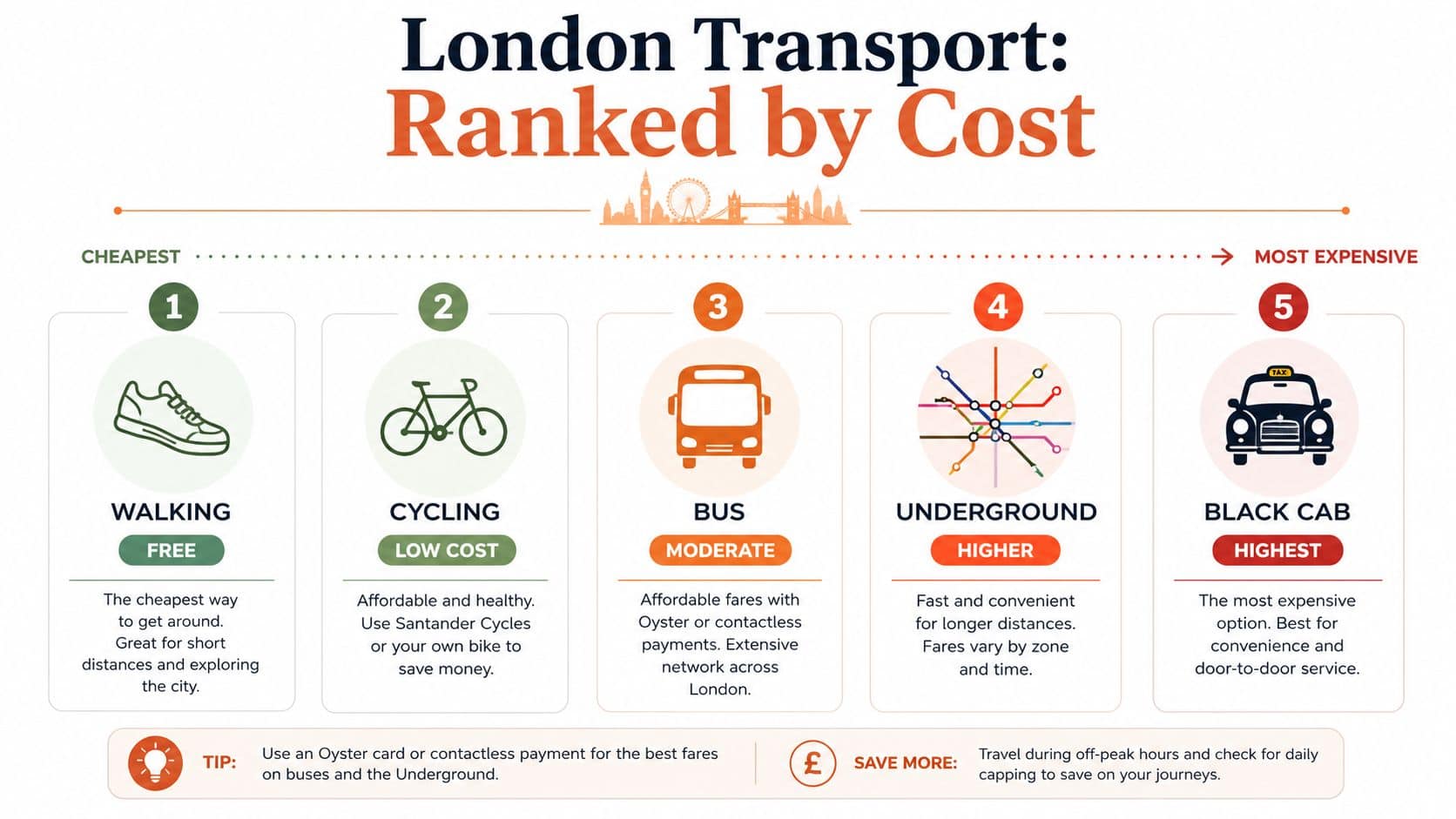
Walking is the cheapest way to move around London, because it costs nothing and gets you between places the Tube skips over. Use it for short hops in the centre, market days, and any itinerary built around one compact area. It is also the only option that never gets more expensive because you forgot to tap.
Use buses when you need to cross town cheaply
The bus is the budget workhorse. A single fare is £1.75, and if you pay with Oyster or contactless, unlimited bus travel costs £5.25 for the whole day. That makes buses the first paid option to reach for when you need wheels but do not want to blow your budget on rail fares. Visit London also points to daily and weekly price caps on Oyster and contactless, so once you are making several journeys in one day, the system starts working in your favour.
Keep rail for longer, not ordinary hops
The Underground, Overground, and Elizabeth line make sense when the walk is too far and the bus would waste time. For airport arrivals, the Elizabeth line from Heathrow to central London costs about £13 one way, which is a useful benchmark when deciding whether rail is better value than a cab or private transfer, as noted in this London budget guide. If the route is just a short inner-city hop, skip rail and spend the money on something better.
Save cabs for real exceptions
Black cabs and rideshares are the most expensive way to get around the city, so they belong at the bottom of your list. Use them if you arrive late, if you are carrying too much luggage, or if you are stuck heading somewhere awkward after a long night. In every other case, you are paying for convenience that buses and trains already cover well enough.
Travel style
Best use
Budget judgment
Walking
Short central hops
Always the first choice
Bus
Sightseeing and cross-town links
Best value paid option
Underground and Overground
Faster longer city moves
Use when it actually saves time
Elizabeth line
Heathrow and longer cross-city runs
Worth it for airport access
Black cab or rideshare
Late nights, luggage, special cases
Keep for emergencies
If you are planning the rest of your trip around cost as tightly as movement, this cheap accommodation guide for Europe is useful reading too, because where you sleep changes how much you spend getting around.
Building a Daily Transport Budget That Works
A solid London day works best when you keep the plan simple. Walk to the first sight, take a bus when the distance starts to feel annoying, then walk again once you are back in a tight cluster of attractions. That pattern keeps your spend down and still lets you see a lot without burning fares on every short hop. For most sightseeing days, a sensible transport budget sits in the £10 to £15 per day range, and daily caps keep the cost from running away if you avoid pointless detours.
What a sensible day looks like
Start with the area you are already in. A visitor based centrally can usually link several sights in one loop and avoid backtracking across town, which is where transport budgets get shredded. If you keep crossing London just to tick off a list, you will spend more on getting around than on the places you came to see.
A practical day often looks like this. Morning walk to a museum or market, one bus across to a second area, then another walk through nearby free sights. If you finish with a short hop back to your base, the day still feels full, but the fare total stays low.
Travel Style
Typical Daily Cost
Best For
Mostly walking, one or two buses
Low, often under the usual sightseeing budget
Central sightseeing days
Mixed bus and rail with capping
Moderate, still controlled by daily caps
Busier days with multiple districts
Airport transfer added in
Higher, because the airport link is a separate major cost
Arrival and departure days
The biggest mistake is treating airport transport like a small add-on. It is not. If you are using the Elizabeth line from Heathrow to central London, budget about £13 one way and build the rest of the day around that bigger hit instead of pretending it barely matters.
Why location changes the maths
Stay too far out and you save on the room but pay for it in travel. Stay central and you often cut out several paid journeys altogether. That is the cleanest way to keep your transport spend under control while still seeing the city properly.
If your hotel choice is pulling your day budget in the wrong direction, read this cheap accommodation guide for Europe and choose a base that reduces your daily fares instead of forcing longer, pricier trips.
For travellers who want to keep every payment tidy, pick the right crypto wallet before you leave home, so you are not juggling extra cards and apps while you are already trying to keep transport spending tight.
Mastering Oyster and Contactless Payments
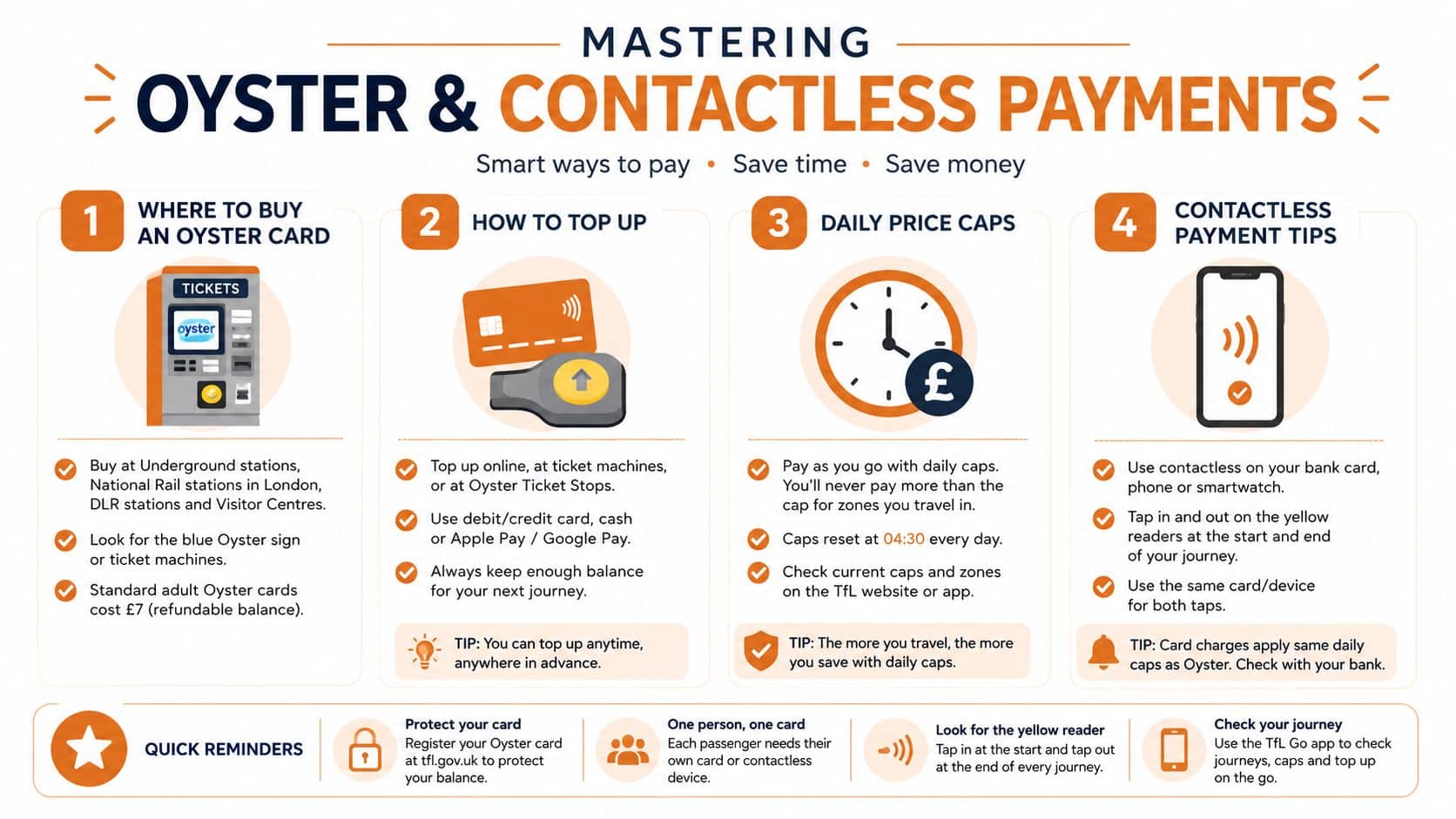
If you’re serious about keeping costs down, use Oyster or contactless and stop thinking in paper tickets. London’s system is built to stop you paying more than you need to, especially through daily and weekly price caps. That’s the whole point, you tap, move, and let the fare rules do the heavy lifting.
The fast way to set it up
An Oyster card is straightforward. Buy one, load credit, and use it where contactless isn’t convenient. If you already carry a bank card or use a mobile wallet, contactless is often easier because you don’t need to preload anything, and the system still applies the cheapest fare rules automatically.
What matters most when you tap
London charges differently at busy times, so avoid the peak windows if you can. Visit London says peak fares apply 6.30am to 9.30am and 4pm to 7pm, Monday to Friday, so shifting even one journey outside those windows can keep a day cheaper. That matters most if you’re chaining together several short trips and don’t want the city’s busiest hours to inflate your spend.
Common mistakes that waste money
Use the same card for the whole trip, or you’ll make the fare system work against you. Don’t mix payment methods randomly. Don’t buy paper tickets unless you have a very specific reason. And if you’re making a lot of bus journeys, remember that the whole point is to let the cap do its job, not to micromanage every single ride.
If you’re sorting other travel payments too, pick the right crypto wallet is a useful general reference for digital payment basics, although London transport itself is best handled with Oyster or contactless, not gimmicks.
Walking Routes That Connect Major Free Attractions
London is one of the rare capitals where walking feels like the smart option, not the poor person’s compromise. Central areas are compact enough that you can stitch together a full day of free or low-cost sightseeing without overthinking transport. That’s exactly how you keep the city budget-friendly and still see the good stuff.
South Bank to Tower Bridge works because the city lines up for you
Start near the London Eye, follow the river east, and keep going until Tower Bridge comes into view. You’ll spend far more time looking at the Thames than at maps, which is the right balance for a budget day out. This route works because the landmarks are naturally spaced for strolling, not sprinting, and you can break it up with low-cost food from casual places along the way.
Covent Garden to Soho to the British Museum is an easy central loop
This is the route I’d give anyone who wants a first-day London walk without transport stress. Covent Garden feeds naturally into Soho, then you can drift north towards the British Museum area. The win is that you stay in one compact zone, so you’re seeing more and paying less.
Use this rule: If a district has three or four things you want to see, walk between them first and only use transport if your legs force the issue.
Hyde Park connects nicely to the museum quarter and Oxford Street
This is the route for a slower day. You can move through Hyde Park, link over to the museum area around Kensington, and then carry on towards Oxford Street without needing to jump on the Tube every time the map looks annoying. If you want a fuller list of free options to weave into routes like this, this guide to free things to do in London is a solid companion.
The reason walking beats over-planning is simple, it reveals the city between the sights. Tube journeys hide those bits. Bus rides and pavement time show them.
Where You Stay Determines How Much You Spend on Transport
Accommodation location changes the whole equation. If you stay close to Zones 1 and 2, you cut down the number of paid rides, and that is often worth more than a slightly lower room rate in a far-flung area. Budget travellers who stay central usually end up spending less overall because they can walk more and bus less.
That’s why the smart move is to treat your bed as part of your transport strategy. If you’re staying in a central area, you’re already halfway to saving money. If you’re stuck on the edge of the city, every “quick trip in” becomes another fare, another wait, and another reason your budget stretches badly.
For a broader look at budget-friendly areas in London, it helps to think in terms of access, not just postcode glamour. The best base is the one that lets you walk to at least some of your plans and reach the rest with a single bus or short rail ride.
That’s where central hostel bases make real sense. St Christopher’s Inns has London properties in locations such as Camden, London Bridge and Greenwich, which keeps you near transport links and in reach of major sights without forcing a daily commute. The direct-booking perks matter too, because you get 25% off food at bars throughout your stay, a free welcome drink, and flexible cancellation, which turns a decent location into better total value rather than just a room.
Central beds aren’t a luxury in London. They’re a transport decision.
If you want the logic mapped out by neighbourhood, where to stay in London is the right place to compare areas before you book.
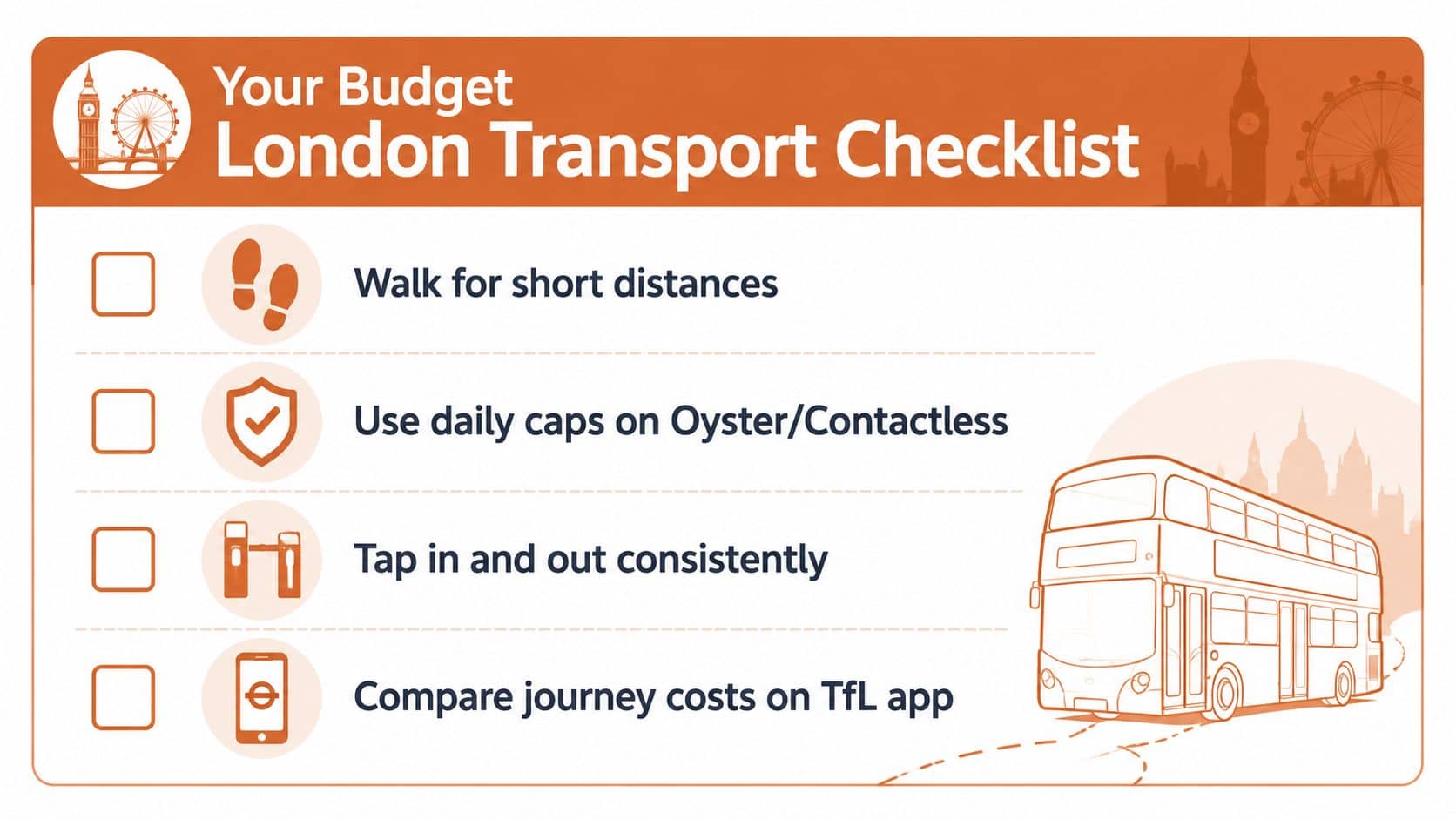
Your Budget Transport Checklist for London
London gets cheaper the moment you stop improvising every movement. Use this checklist and you’ll avoid the usual mistakes, like overusing rail, buying unnecessary tickets, or staying somewhere that turns every outing into a long commute.
Keep it simple
Walk for short distances. It’s free, and central London is compact enough to make this really useful.
Use daily caps on Oyster or contactless. Let the system stop you overpaying when you’re moving around a lot.
Tap in and out consistently. Use the same card each time so the fare rules work properly.
Compare journey costs on the TfL app. Check the route before you commit, especially when you’re choosing between bus and rail.
A couple of small habits help too. Keep a reusable water bottle with you so you’re not buying drinks every time you feel thirsty, and don’t let the day drift into random cross-city hops. If you can keep your sightseeing in one area, you’ll spend less and enjoy more.
If you want a central base that makes this whole plan easier, St Christopher’s gives you affordable London stays with social on-site bars, practical locations, and the kind of access that cuts transport waste. Book direct at St Christopher’s if you want budget accommodation that helps you spend more of your money on the city itself and less on getting across it.
Our direct rates are guaranteed to be at least 5% cheaper than anywhere else online, with a free drink on arrival, 25% off food at the bar, and free cancellation options available.