How to Travel Europe on a Budget Without Missing Out
Phill
You're probably doing that familiar late night spiral right now. A dozen tabs open. London, Paris, Amsterdam, Berlin. One budget...
Share This Article
You're probably doing that familiar late night spiral right now. A dozen tabs open. London, Paris, Amsterdam, Berlin. One budget airline fare looks brilliant until bags, airport transfer, hostel, city tax, mobile data and one bad meal in a tourist square turn your “cheap” trip into something that suddenly feels stupidly expensive.
That's the trap.
How to travel Europe on a budget isn't about hunting one bargain flight and hoping the rest sorts itself out. It's about making a handful of boring, smart decisions early, so you don't spend the trip panicking at your banking app. If you get the route, pace and base right, Europe can still be affordable without turning into a sad procession of supermarket sandwiches and missed trains.
Picture This Before You Book Anything
It's 11pm. You've found a flight. You add Amsterdam because it's close. Then Paris because obviously. Then Berlin because everyone says it's cheaper once you're there. The total climbs. You close the tab and tell yourself you'll “look properly tomorrow”.
I've done it. Many travelers do it. The mistake is thinking the flight is the trip.
For UK travellers, Europe is still the default overseas trip. In 2023, 66.7 million of the UK's 86.2 million outbound trips abroad were to Europe, which was 77% of all trips, and the average visit to Europe lasted 8.8 nights according to the UK travel statistics briefing. That matters because the classic Europe trip for British travellers is not a grand three month rail odyssey. It's a short or medium break where every transfer, every bed move and every bad booking choice bites harder.
Start with three decisions
Before you book anything, settle these:
Trip length: A long weekend, one week, two weeks, or a month all need a different rhythm. Cramming four cities into eight nights is how you spend half the trip dragging a bag to stations.
Country mix: Western and Nordic Europe usually cost more day to day than Eastern Europe, while Spain, Portugal and Greece tend to sit in a more manageable middle band.
Base style: Hostel hop every few nights, stay put in one city and do day trips, or mix both.
That third one matters more than people think. A dorm bed in a central city hostel can save money if it cuts local transport and gives you a social base. But changing beds too often gets expensive in other ways. Laundry, lockers, late arrivals, snack spending, wasted afternoons. It all adds up.
Practical rule: If you're travelling for under ten nights, don't build the trip around constant movement. Pick fewer cities and do them properly.
The two mistakes that burn cash first
The first is overspending in week one because you booked a route that's too ambitious. You arrive tired, wing it, pay walk-up fares, grab food near landmarks and say yes to every plan because you feel you should.
The second is under-planning transport between cities. A route that looks tidy on the map can be awkward in real life. One cheap fare out of a far-flung airport can wipe out the saving once you add buses, time and stress.
British tourists are spending more overall too. Overseas travel spending reached £77.396 billion in 2024, up 6.8% from 2023, while average trip length fell from 10.4 nights in 2023 to 9.6 nights in 2024, based on UK outbound spending data. Shorter trips with higher overall spending should tell you exactly where to focus. Not on fantasy hacks. On the decisions that shape the whole trip.
Where Your Money Actually Goes in Europe
Budget trips in Europe are rarely blown up by one expensive museum ticket or an extra coffee. They get blown up by the big repeat costs. Beds. Transport. Food bought in the wrong places. And for UK travellers, the post-Brexit extras that many guides still treat like footnotes, such as roaming charges, airport taxes folded into fares, and overpriced meals grabbed in tourist zones because the day's plan went wrong.
Start with the two categories that keep hitting your card every day. According to Eurostat's tourism expenditure breakdown, accommodation takes about 36% of tourist spending, transport about 29%, and other costs the remaining 35%. That is why the cheapest trip is usually the one with fewer moves and a bed in the right area, not the one where you spend the whole week hunting for 2 euro savings.
Average Daily Europe Budget Split by Category
Category
Share of Budget
What it Covers
Best Saving Move
Accommodation
35 to 40%
Dorm bed or simple private, preferably central
Pay for location if it
cuts daily transport
Transport
25 to 30%
Intercity travel, metro, airport runs
Change cities less often
Food
20 to 25%
Bakery breakfast, simple lunch, one solid meal
Eat one block back from the sights
Attractions and buffer
Remaining spend
Entries, drinks, small mistakes, tourist taxes, roaming or admin costs
Pick a few paid highlights and keep slack in the budget
The table matters because it forces real choices.
A central hostel that costs a bit more can still be the cheaper option if it saves two metro rides, a late-night taxi, and the temptation to buy rubbish food near the station. A dirt-cheap flight can be a bad deal once Air Passenger Duty, baggage, airport transfers and bad timing are baked in. UK travellers get caught by this all the time.
What a sensible day pays for
On a normal budget day, your money should cover four things without stress:
A clean bed in a central or well-connected area
Local transport, or one intercity cost spread across the trip
Food that keeps you going without living on snacks
One paid sight, or a free day built around markets, parks, viewpoints and walking
If your budget cannot cover that, the route is too expensive or too busy.
Before you leave, trim the pre-trip waste too. These budget boosting techniques are useful for building the fund in the first place, especially if you want extra cash without turning the trip into an exercise in self-denial.
The hidden costs UK travellers should price in early
Many Europe budget guides fall short. Flights and hostels are only part of the total.
For UK travellers, roaming can still sting if your network no longer includes EU data. A “cheap” stay on the outskirts often leads to more spending on transit, coffee stops while waiting around, and late convenience food. Airport choices matter too. A bargain fare out of a far-flung airport can stop looking cheap once you add the train there, the meal deal on the platform, and the risk of paying more because your whole day now has to bend around that flight.
Then there is food near landmarks. This is one of the easiest ways to bleed money without noticing. Move a few streets away and prices often drop fast. Lunch deals, bakeries, supermarket picnics and set menus do more for your budget than obsessing over whether to skip a beer.
Pick the right cost band for the region
Your route decides your daily spend long before you land. A Post Office guide to affordable European city breaks notes that cheaper eastern destinations can come in around 70 euros a day, while cities in France, Switzerland and Scandinavia can push well beyond 100 to 110 euros a day.
That gap is the difference between stretching a trip and cutting it short.
If you want city-level, hostel-first advice, St Christopher’s guide to saving money while travelling is a useful companion. Use it after you set the route and cost band, not before. The biggest savings come from choosing the right places, spacing, and base. The small hacks only help once those decisions are sorted.
Planning and Booking Timeline That Saves Money
The trip gets cheaper when you stop treating it like one giant booking and break it into stages. Flights, beds, transport between cities, and admin all move on different timelines. If you wait and do everything at once, you’ll either overpay or make rushed choices.
Six months to four months out
At this stage, lock the big shape of the trip.
Fix the route Decide your entry city, exit city and no more than one or two backup swaps. Don’t “stay flexible” if what you really mean is “avoid deciding”.
Set a daily spending cap Not a fantasy number. One you can follow in the places you’ve picked.
Open a travel-friendly bank account You want a card that handles foreign spending cleanly and doesn’t punish you for using it abroad.
Start a sinking fund Move a set amount into it every week. If the trip fund feels painful now, the route is too ambitious.
At about four months, book the expensive fixed pieces. Your main flights if you need them. Peak rail if you’re taking something popular or time-sensitive. Any route where the cheap seats tend to disappear early.
Three months to six weeks out
This is the sweet spot for beds and must-do bookings.
Book key hostels in high season cities: Amsterdam, Paris, Barcelona and central London get awkward if you leave them too late
Reserve timed attractions you genuinely care about: Not everything. Just the things you’ll be annoyed to miss
Fill in intercity gaps: Buses, trains, night travel, whatever matches your route and tolerance for discomfort
Book the expensive, fixed bits early. Leave the flexible bits until you know how the route is actually shaping up.
If you need a route framework to build from, this European travel planner is a good starting point for sequencing cities without zigzagging.
Two to four weeks out
This is admin week. Dull, but money-saving.
Check passport validity
Check your GHIC or EHIC
Confirm visa rules if your route includes countries with different entry setups
Book airport transfers where late arrivals make winging it risky
Screenshot bookings and tickets
Download offline maps
Then stop tinkering.
The habit that saves the most money is boring and reliable. Book the fixed expensive stuff first, then fill the gaps later. That’s how you avoid gambling on the longest journeys and panic-booking a bad bed the night before.
Cheap Ways to Move Around Europe
Transport is where budget travellers either look clever or get rinsed. There isn’t one “best” option. There’s the right one for the route you’re doing.
Cheap Transport in Europe at a Glance
Mode
Average price
Journey time
Best for
Watch out for
Budget airline
Lower end when booked well
Fast in the air, slower door to door
Big jumps between far cities
Baggage rules, airport transfers
Intercity bus
Usually affordable
Slow to moderate
Flexible travellers, shorter budgets
Overnight comfort varies
Train
Mid-range to higher
Efficient city centre to city centre
Comfort, scenery, easy stations
Popular routes can get pricey
Night train or sleeper bus
Varies
Travel while you sleep
Saving a travel day and one night’s stay
Sleep quality, security, arrival time
Flights win on distance, not always on value
If you’re crossing a big stretch, flying can still make sense. Barcelona to Berlin, London to southern Europe, or a late-stage jump that would otherwise eat a full day on land. But a “cheap” flight stops looking cheap once you add the airport bus, bag fee, food because you left too early, and half a day lost to check-in and waiting around.
Use flights for long jumps, not every leg.
Buses are ugly, useful and often the right answer
Intercity buses are rarely glamorous. They are, however, practical for plenty of budget routes, especially when train prices are annoying or you want a direct overnight leg.
They suit travellers who care more about cost than comfort, and who can handle a late arrival without becoming a nightmare to be around.
Trains are usually the least stressful option
Trains often win where the distance is moderate and the route is popular. City centre to city centre is a real advantage. You skip airport faff, baggage drama and weird industrial-edge terminals.
They’re especially good when:
You’re carrying more than one bag
You’re travelling in shoulder season
You want the day to remain usable
You hate uncertainty
Night travel is only a bargain if you can function after it
A sleeper bus or night train can save a bed and a travel day. Great on paper. Less great if you arrive wrecked, pay to store your bag, buy too much coffee, then waste the day because you can’t think straight.
Night travel works best before a low-pressure day, not before your biggest sightseeing plan.
My rule of thumb is simple:
Short to medium route with easy rail links, take the train
Route where rail is awkward or pricey, take the bus
Long jump, consider a flight
One overnight move max in a short trip, unless you already know you sleep well in transit
Budget Stays That Still Feel Central and Social
Accommodation is where people get falsely economical. They save a few euros or pounds a night, then spend more getting into town, more time commuting, and more effort trying to meet people because the place has no atmosphere.
A central bed beats a bargain bed in the middle of nowhere.
What actually matters in a budget stay
Look at these first:
Walking distance from station or main sights
Late check-in that doesn’t become a drama
Locker space and decent shared areas
A kitchen or reliable food nearby
A social setup that feels natural, not forced
For solo travellers, this matters even more. A silent building with no communal life can make a city feel oddly expensive because you start paying for every social moment outside it.
The real hostel maths
A dorm bed for €30 to €40 in Western Europe can be better value than one for €25 further out, because centrality saves local transport and lost time. That price context lines up with the European budget accommodation ranges already covered earlier.
Hostels work best when they do three jobs at once:
Sleep base
Transport saver
Social shortcut
Which kind of stay suits which trip
Social hostels
Best for solo travellers, short breaks, and anyone who wants to meet people without turning networking into a task. In cities like London, Paris, Berlin, Amsterdam, Barcelona, Bruges, Edinburgh and Newquay, that social layer can save both money and hassle.
Budget hotels
Better if privacy matters more than atmosphere. Fine for couples or one-city stays, less useful if you’re trying to make friends on the move.
Apartment stays
Good for longer stops. Worse for short city breaks unless the cleaning fees and transport setup still make sense.
Eating, Seeing Things and Having a Night Out for Less
You do not need to eat pasta from a hostel pot every night to keep Europe affordable. You do need a bit of discipline. The trick is to spend on the things you’ll remember and cut the spending that happens because you were tired, underprepared or standing beside a famous square.
Food that feels like travel, not punishment
British travellers already spend a lot on accommodation. The UK briefing notes that 37.7% of British outbound travel spending went on accommodation in the cited dataset from the UK travel statistics briefing. That’s exactly why food needs a system, not constant impulse buying.
Use this rhythm:
Breakfast from a local supermarket Yoghurt, fruit, bakery stuff, coffee. Simple.
Lunch as your proper meal Lunch deals and set menus are often better value than dinner.
Dinner kept flexible Street food, market halls, something from a kitchen, or one drink and snacks if lunch was big.
Sightseeing without paying for everything
Most cities offer more free value than first-timers realise.
Free walking tours are still one of the best first-day moves. Tip what you can.
Parks, churches, markets and neighbourhood walks do a lot of heavy lifting.
Museum tickets are worth paying for when you care, not because the guidebook says so.
City cards only make sense when you’ll use enough included entries.
If a city card doesn’t pay for itself by your second real use, skip it.
Many travellers waste money here. They buy access to twelve attractions, visit three, then claim the city was expensive.
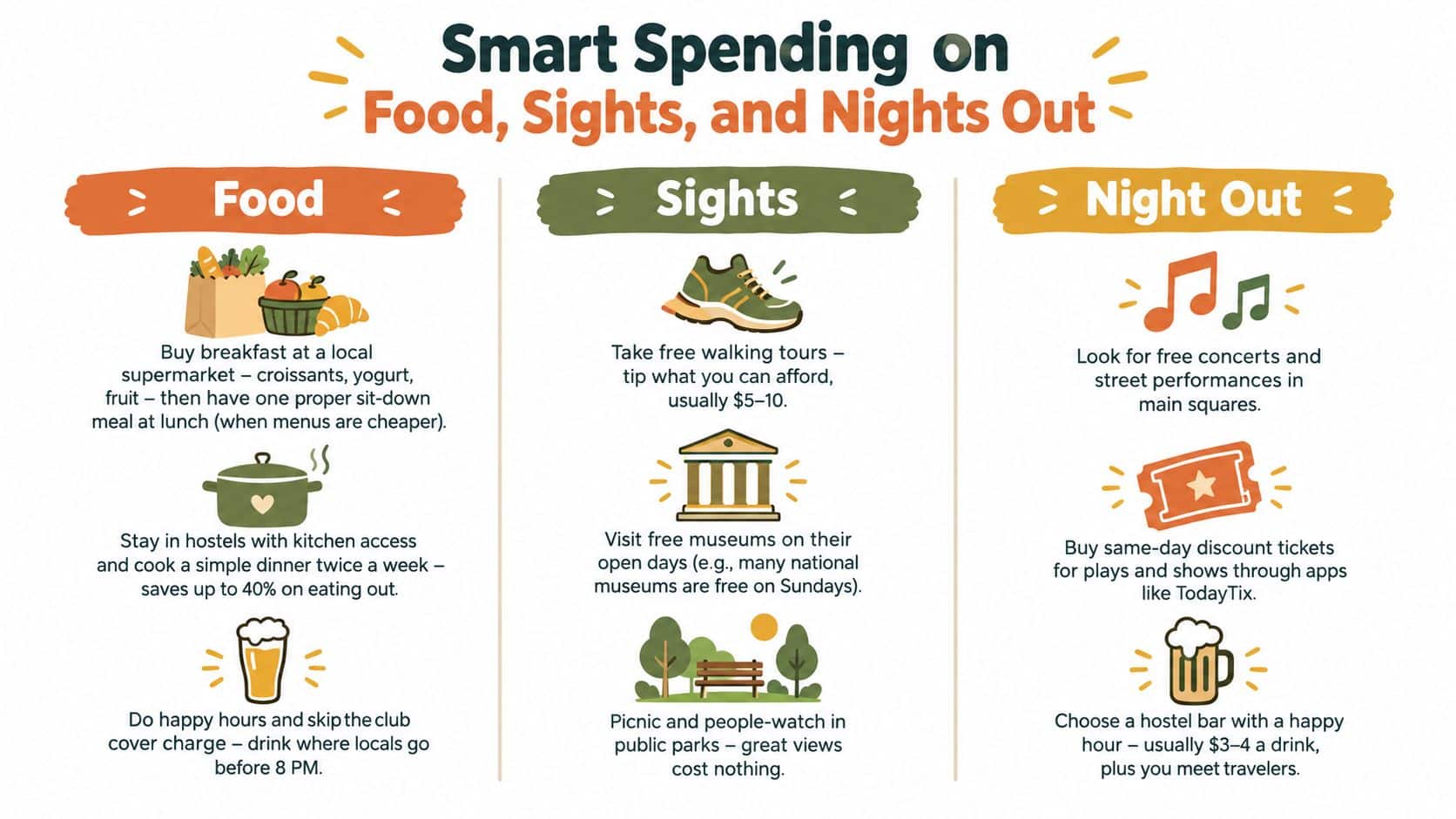
To keep the daily basics scannable, this quick visual covers the food, sights and nightlife habits that usually save the most.
Nights out without the tourist-trap tax
Nightlife gets expensive when you bounce into obvious places near landmarks. Better plan:
Start where travellers and locals already mix
Use happy hour properly
Skip cover charges unless you really want that venue
Choose one proper night out rather than six vague expensive ones
On-site bars help because they cut the “where do I even go tonight” problem.
The hidden UK-specific costs that catch people out
This is the bit many Europe budget guides barely mention, and it’s where UK travellers lose money after they’ve already “booked the cheap trip”.
According to this UK and EU roaming explainer, mobile roaming for UK travellers now ranges from included EU roaming to daily passes of roughly £1.50 to £6 per day, and older pay-as-you-go charges can run as high as £6 per MB. That’s not a niche problem. That’s the difference between using maps freely and being weirdly scared to open your phone all week.
Check your provider before you fly. If roaming isn’t included, sort an eSIM or a travel data setup before departure. Don’t land and improvise.
The same source notes that UK Air Passenger Duty for Band A destinations is due to rise from £13 to £15 in economy from April 2026. It’s a future change, not a current one, but it matters if you’re planning ahead or splitting a route into lots of separate flight sectors. More flying segments from the UK means more tax friction.
Then there are city taxes. They vary by place and property, and many hostels collect them separately. I always assume they’ll be there and keep a small nightly buffer for them rather than acting shocked at check-in.
One sample low-spend day
Here’s what a disciplined but enjoyable day in a cheaper city can look like:
Breakfast: supermarket pastries, fruit, coffee
Morning: free walking tour
Lunch: filling local special, not beside the main square
Afternoon: park, market, viewpoint, cheap museum or no museum at all
Evening: happy hour drink, affordable dinner, social bar instead of club crawl
That kind of day keeps spending under control without making the trip feel mean.
The same logic applies everywhere. Save on the routine. Spend on the memory.
Sample Itineraries for a Weekend, Two Weeks and Longer
The fastest way to make your trip cheaper is to steal a route that already makes sense, then adjust it. People waste money trying to design the perfect bespoke itinerary when they’d be better off copying a proven one and swapping one city at a time.
Weekend route with minimal faff
London to Amsterdam works because the transition is clean, the city is compact, and you can do a lot without overcommitting.
Stay in Amsterdam at The Flying Pig Downtown if you want a social city-centre base. Spend one day wandering canals, renting a bike if that’s your thing, and keeping most of the day outdoors. In the evening, a food hall or casual shared dinner keeps the night affordable without turning into another overplanned booking.
This sort of weekend works best when you:
Travel light
Book transport and bed early
Avoid adding a second city just because it looks close on the map
A short break only feels budget-friendly when it stays simple.
Two weeks with enough movement, not too much
A strong first two-week route for UK travellers is:
London
Paris
Berlin
Amsterdam
Back to London or onward from Amsterdam
This kind of trip becomes affordable when you mix your transport modes instead of getting ideological about trains or flights. One rail leg, one bus leg, maybe one flight if the route demands it. Not every segment needs to be romantic.
Lock the first three nights in each city if you can. It removes the worst panic-booking premium and gives you room to adjust later nights if needed.
For sightseeing, each stop should have one anchor plan and one free fallback. That keeps you from spending badly on the days when the weather, your energy or transport delays throw things off.
Longer backpack loop that doesn’t implode
If you’ve got more time, stop thinking in terms of “as many capitals as possible”. Think in clusters.
A cleaner long route is:
London
Paris
Amsterdam
Berlin
Barcelona
Bruges or Edinburgh on the way back, depending on your direction
That route works because it leans on cities with known backpacker infrastructure and properties where solo travellers can settle in fast. You can stretch each stop, use night travel selectively, and swap one expensive city for a cheaper one if your funds tighten.
If you’re planning with friends or family as well, some route logic overlaps even if the accommodation style changes. For mixed-age travel ideas that think in terms of region and activity rather than random city collecting, these 2026 family trip ideas Europe are useful for destination pairing.
How to swap cities without blowing the budget
Do not swap one city for another based on Instagram mood alone. Swap based on these questions:
Does the replacement sit in the same cost band
Can you reach it without creating an awkward extra travel day
Will the bed and station area still work for your arrival time
Does the swap improve the route, or just satisfy curiosity
Western and Nordic Europe sit in the higher daily-cost band, while Eastern Europe is generally lower, and the UK remains among Europe’s pricier destinations in recent budget guides. One cited 2026 benchmark puts the average per-person cost of a 9-night holiday abroad at £1,389, while London is estimated around $130 to $250 per day and the UK generally around $110 to $150 budget per day, according to this Europe trip cost guide. You don’t need to memorise those numbers. Just use the lesson. Your destination mix matters more than your coffee budget.
Your pre-departure checklist
Eight weeks out
Fix route and core nights
Book first major transport legs
Check passport validity
Sort travel insurance
Check GHIC or EHIC
Four weeks out
Book first-night activity in each city if useful
Confirm hostel terms and any deposits
Plan airport arrival into city centre
Check mobile data or eSIM setup
One week out
Download offline maps
Screenshot bookings
Prepare a small euro cash buffer if your route needs it
Review baggage rules for any flights
Night before
Charge power bank
Check departure platform or airport transfer
Put passport somewhere obvious
Sleep properly if you can
The big habit is still the same. Book the big three first: transport, bed, and your first-night plan. Once those are sorted, the rest of the trip gets easier. You’re no longer paying panic prices. You’re just editing details.
Copy one of these itineraries into your notes app, cut a city if the route looks too busy, and build from there. That’s a much better way to travel Europe on a budget than chasing random deals and hoping they join up.
If you want a budget-friendly base in the cities that come up again and again on Europe routes, St Christopher’s gives you central hostels, social spaces, and useful direct-booking perks like a free welcome drink, free cancellation and 25% off food. That combination matters when you’re trying to keep transport, meals and last-minute stress under control, not just the room price.
Our direct rates are guaranteed to be at least 5% cheaper than anywhere else online, with a free drink on arrival, 25% off food at the bar, and free cancellation options available.