What Is Sustainable Travel and How to Travel Better
Sophie
Sustainable travel is tourism that balances environmental, social and economic impacts so the places you visit stay healthy for residents,...
Share This Article
Sustainable travel is tourism that balances environmental, social and economic impacts so the places you visit stay healthy for residents, businesses and future travellers. In the UK, 29% of adults have already looked for sustainable holiday accommodation, and 73% of those people said it’s easy to find sustainable options in England, which tells you this is no longer a niche concern (VisitBritain research).
You might be packing for a weekend in Berlin, trying to work out whether the train is worth the extra faff, or wondering if your hostel choice really makes any difference. It does, and not in some preachy, abstract way. The decisions that matter most are usually the ordinary ones, where you sleep, how you get there, what you eat, and how much of the trip stays local.
What Sustainable Travel Actually Means
You don’t need a big trip or an eco badge to make sense of this. If you’re heading to Lisbon for three nights, sustainable travel is the habit of making choices that lower harm, support the people who live there, and keep the place worth returning to.
The UN’s definition is the clearest starting point. Sustainable tourism takes full account of its current and future economic, social and environmental impacts, while also meeting the needs of visitors, the industry, the environment and host communities (UN sustainable tourism).
That sounds formal, but the everyday version is easier. It means you think about how you travel, where you stay, who benefits from your spending, and whether your visit leaves a place more strained or more resilient.
A lot of people assume sustainable travel is only about nature trips or cutting out flights entirely. It isn’t. The practical version is broader, and for most European city breaks it comes down to choosing lower-impact transport, staying somewhere central enough that you can walk or use public transport, and spending money in ways that support local businesses instead of draining value away.
For a good example of how sustainable tourism can work in a destination setting, the Lake Bled travel guide from Outdoor Slovenia Activities shows how visitor choices and local stewardship fit together without making the trip feel like a compromise.
What that means in plain English
If your hostel is in the centre, you walk more and spend less on taxis. If you take the train instead of a short flight, your journey usually carries less environmental load. If you eat in places run by local owners, more of your money stays in the neighbourhood.
That’s the useful test. Sustainable travel isn’t a lifestyle club, it’s a set of small decisions that add up.
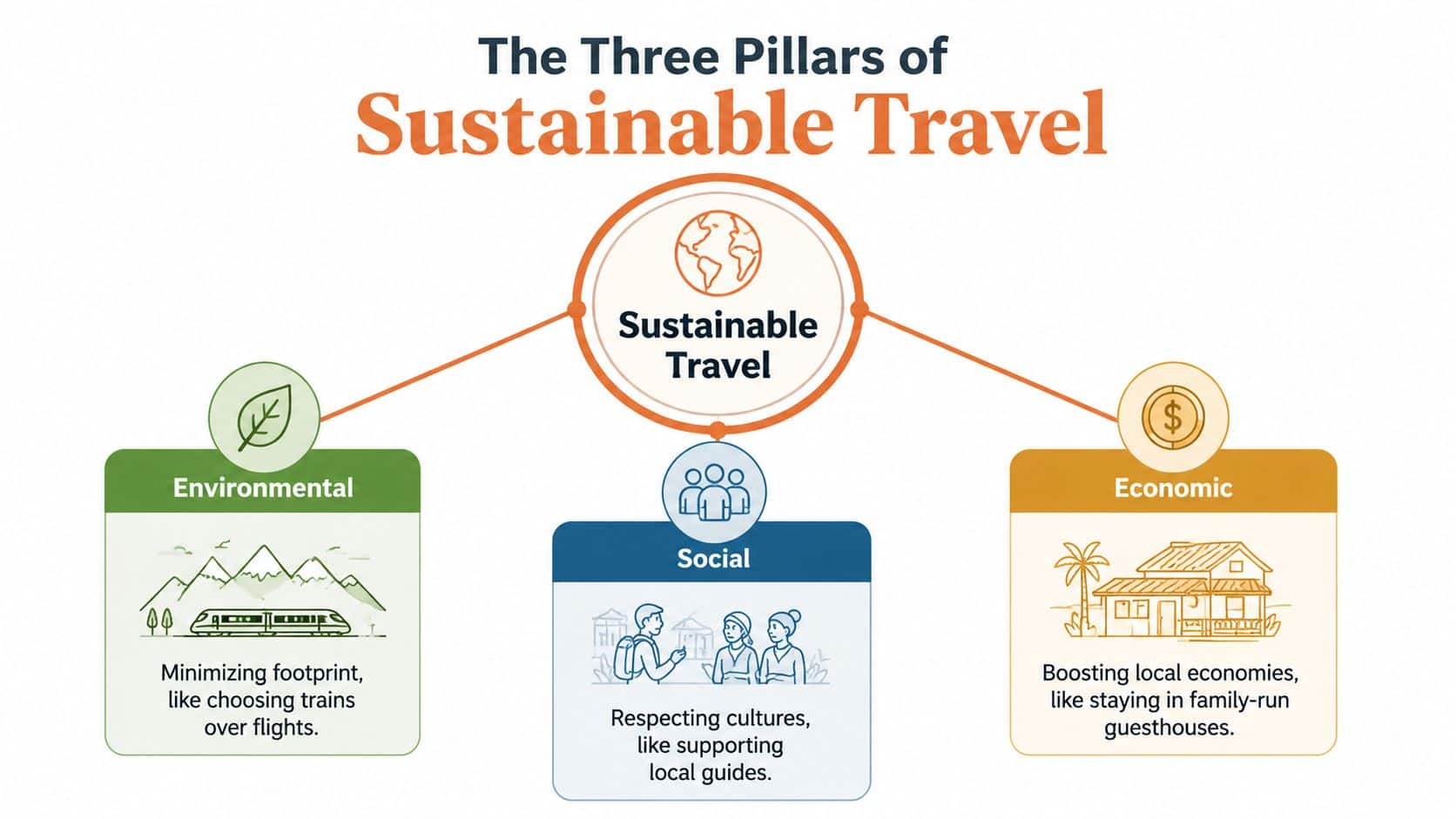
The Three Pillars Explained Simply
Think of sustainable travel as three questions you ask before you click book or hail a taxi. Does this choice reduce harm to the environment, does it respect the place and the people, and does it help money stay in the local economy?
Environmental, the obvious one, but not the only one
This pillar covers transport emissions, energy use, waste and water. The UK government’s transport emissions data show why mode choice matters so much, especially on short domestic and near-Europe trips, because transport is a major source of greenhouse gases, and the WTTC says travel and tourism contributes 7.3% of global greenhouse gas emissions (Condor Ferries sustainability statistics).
A good hostel-travel example is choosing the train from one European city to the next rather than a short-haul flight, then staying somewhere central so you don’t keep adding taxi journeys. If you’re carrying a refillable bottle and using shared laundry sensibly, you’re still in the same pillar.
Social, the part people forget
This is about how your trip affects residents and culture. The UN framing matters here because a destination isn’t just scenery, it’s someone’s home. Respecting quiet hours, not crowding a tiny street at night, and booking a local walking tour all sit in this category.
Practical rule: if your choice makes the place easier to live in for residents, it’s probably moving in the right direction.
Economic, where your money lands
This pillar asks whether your spending reaches local people or gets skimmed away before it does much good. Eating near your hostel at a family-run place, paying for a guided walk run by a local, or choosing accommodation that keeps more of the booking value in the property all help.
The strongest version of this is simple. Spend in ways that support the neighbourhood you’ve come to enjoy.
Common Myths That Put Travellers Off
A lot of people dismiss sustainable travel before they’ve really tried it. Usually, it’s because they’ve picked up one of five myths that make the whole idea sound awkward, expensive or a bit performative.
Myth one, it’s expensive
It can be if you turn it into a boutique hobby. It doesn’t have to be. Walking instead of taking a taxi, using a metro day pass, or staying in a central dorm that cuts transport costs can make the sustainable option the more budget-friendly one.
Myth two, it’s only for serious eco travellers
No, it’s for anyone who travels at all. You don’t need a bamboo toothbrush collection or a lecture about global systems to do it properly. Carrying a reusable bottle, choosing one local meal a day, and skipping an unnecessary transfer are already meaningful habits.
Myth three, it’s just about flying less
Flying matters, but that’s not the whole story. Sustainable travel also covers where you stay, what you eat, how much you move around once you’re there, and whether local businesses benefit from your visit. A short break can still be more or less sustainable depending on those choices.
Myth four, it’s a marketing gimmick
Some of it is, which is why you need a practical definition. If a place is walkable, uses shared rooms well, offers refill stations, and sits close to public transport, those are concrete design choices, not slogans.
Myth five, it’s impossible on a hostel budget
That one falls apart fastest. Budget travellers already make many of the right calls without naming them as sustainable, especially when they book central accommodation, eat simply, and use public transport instead of private cars. The trick is to make those choices deliberate.
For a more personal check on your own habits, St Christopher’s has a short how sustainable are you while travelling guide that works well as a reality check before a trip.
Why Individual Choices Matter
The reason this topic keeps coming up is simple. Travel and tourism contributes 7.3% of overall global greenhouse gas emissions according to WTTC, so the sector is big enough that small behaviour changes matter in aggregate (WTTC sustainability). At the same time, demand is moving. The 2024 Booking.com Sustainable Travel Report published via GSTC says 75% of global travellers want to travel more sustainably in the next 12 months (GSTC report).
That combination matters for a weekend break in Europe. A single trip can swing quite a lot depending on transport mode, how far the hostel is from the sights, and whether you keep adding taxis and transfers. A short stay is not automatically low-impact just because it’s short.
Where the biggest levers usually are
Transport usually has the heaviest weight, especially on city hops where rail or coach can replace a flight. After that comes accommodation choice, because a central place reduces extra movement. Then comes the simple stuff, like reusing towels and not buying more single-use items than you need.
The point isn’t perfect travel. The point is choosing the decisions that carry the most weight first.
That’s why a central hostel can be part of the answer rather than a trade-off. If you sleep near the things you want to see, you walk more, spend less on getting around, and usually end up using the city more like a local and less like a rushed visitor.
If you like to test your own habits, the short cheap accommodation in Europe guide is a good reminder that affordability and lower-impact travel can overlap when you pick location carefully.
Practical Sustainable Travel Habits That Save Money
If you want the version that works on a backpacker budget, start with the boring choices. They’re the ones that usually save money as well as emissions.
Getting there and moving around
For short European distances, look at the lowest-emission transport that fits your timing and budget. Trains often make the most sense when you’re city-hopping, because they take you into the centre and reduce the need for airport transfers. Once you arrive, walking and public transport usually beat repeated taxi rides, and they leave you more room in the budget for the stuff you came for.
Packing and everyday carry
Bring a refillable bottle and a reusable bag. They’re dull items, but they stop a steady trickle of unnecessary waste. If you’ve ever bought the same thing twice because you forgot a bag, you already know how quickly those little costs stack up.
Eating and activities
A cheap meal at a local market or a family-run place near your hostel is often a better use of money than a chain dinner in a tourist strip. The same logic applies to activities. A free walking tour, a local museum, or a community-run walk gives you a better sense of place than spending every evening in the same loud district.
For a broader set of low-effort habits, this guide on how to shrink your carbon footprint is useful because it focuses on everyday behaviour rather than guilt.
Sleeping well, not just cheaply
Central accommodation is one of the easiest wins. If you stay where the city is walkable, you cut extra trips and often feel the trip more fully because you’re not always in transit. Shared rooms also make sense on a resource basis because the footprint is spread across more guests.
Habit
Environmental
Social
Economic
Train instead of short-haul flight
Yes
Walk or use metro day passes
Yes
Yes
Yes
Refill bottle and reuse bag
Yes
Yes
Free walking tour with a local guide
Yes
Yes
Eat at a local market
Yes
Yes
Stay central in a walkable area
Yes
Yes
Yes
A screenshot-friendly pre-trip check
Pick the lowest-emission route that still fits your trip length.
Book a central stay so you can walk more and taxi less.
Pack reusable basics, bottle, bag, and any toiletries you always forget.
Plan one local meal a day so your spending stays in the neighbourhood.
Choose one free or low-cost activity that gets you out on foot.
Keep laundry and towel use sensible if you’re staying several nights.
Book direct where it makes sense, especially if the total value is better.
A hostel stay can support sustainable travel because of how it’s designed. Shared rooms mean more people use the same footprint, and central locations mean fewer transfers, fewer taxi rides and less time spent crossing a city just to get back to bed.
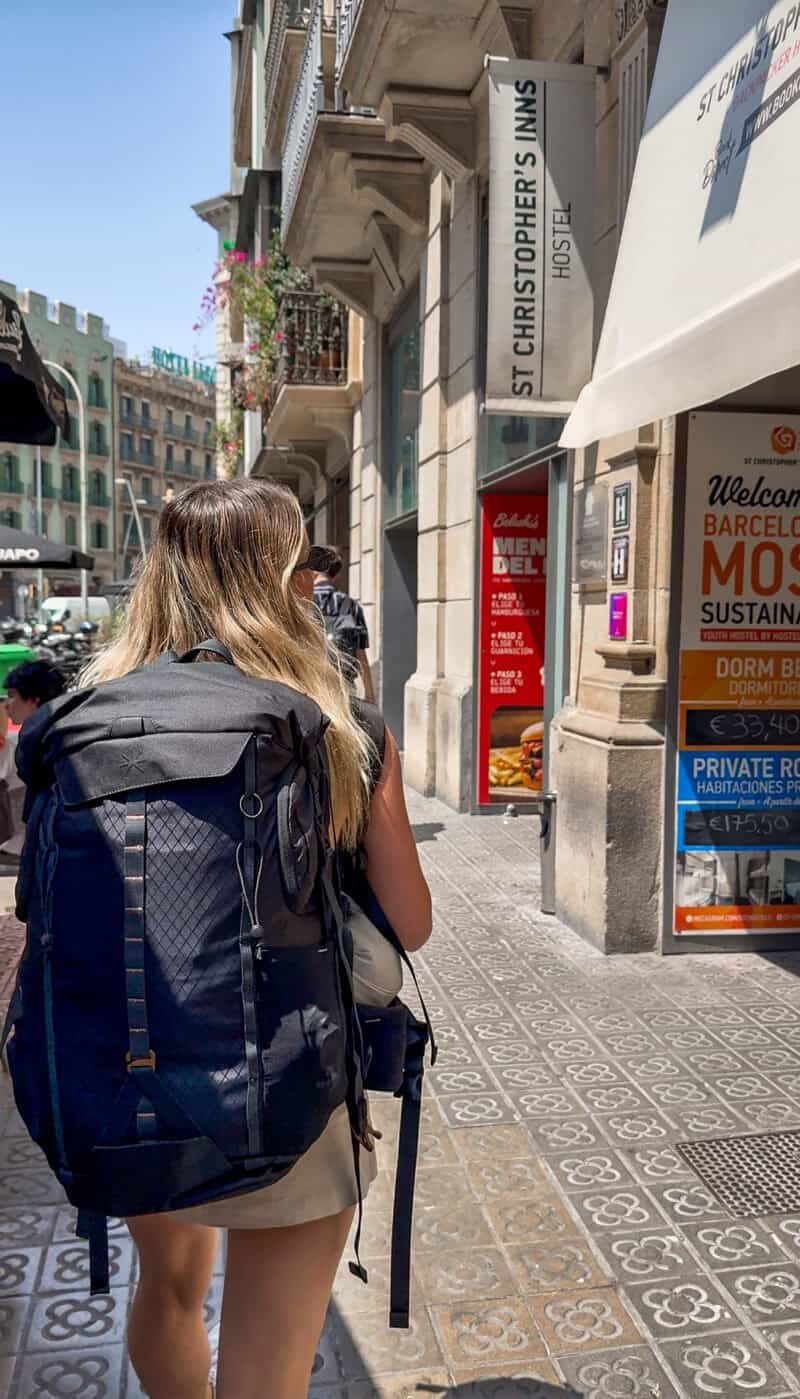
St Christopher’s and the Flying Pig hostels fit that logic well in different cities. In London, Paris, Berlin Alexanderplatz and Barcelona, on-site Belushi’s spaces give guests somewhere to eat and socialise without needing another night out across town. In Bruges, The Bauhaus is a traditional Belgian beer house in a UNESCO-listed building, which keeps the evening social life local rather than scattered.
Why the layout matters
A place in the centre changes the shape of the trip. If you’re walking from your bed to museums, bars, parks and stations, you’re not layering on extra carbon-heavy journeys just because your room was cheaper on the edge of town. That is especially useful on a three-night stay, where the room itself is only part of the footprint.
Booking direct also matters because more of the spend stays inside the operation rather than being lost to commission. At St Christopher’s, direct booking comes with travel-friendly perks such as a free welcome drink, 25% off food at the bars during your stay, flexible free-cancellation options and direct customer service, which makes the value more than just the bed.
Honest trade-off: dorm life isn’t for everyone, and central locations can cost more than a place on the edge. The reason they still make sense here is that the overall trip often gets simpler, more social and less transport-heavy.
The Flying Pig hostels in Amsterdam and St Christopher’s properties across London, Paris, Berlin, Barcelona, Bruges, Edinburgh, Bath, Greenwich and Newquay all show the same pattern in different ways. When the bed, the social space and the location work together, you end up making fewer wasteful choices without having to think about them all day.
Your Pre-Trip Sustainable Travel Checklist
If you want a simple rule set for your next European break, keep it short enough that you’ll use it.
Choose the lowest-emission transport that still fits your budget and timing.
Book a central place to stay so walking becomes the default.
Pack reusable basics like a bottle and tote.
Look up one local business or market you want to support each day.
Plan to use less water and energy while you’re away.
Book direct when the total value is better, not just the headline rate.
The useful part of sustainable travel is that it gets easier with practice. Once you start making a few better decisions per trip, they stop feeling like sacrifices and start feeling like the normal way to travel.
If you want a central, social base for your next city break, St Christopher’s keeps the practical bits simple, with walkable locations, shared spaces and direct booking perks that help your budget go further. Take a look at St Christopher’s and use your next trip to make sustainable travel feel normal, not niche.
Our direct rates are guaranteed to be at least 5% cheaper than anywhere else online, with a free drink on arrival, 25% off food at the bar, and free cancellation options available.