You land in Berlin, drag your bag through Alexanderplatz or step out near Brandenburg Gate, and the city doesn't wait...
Share This Article
You land in Berlin, drag your bag through Alexanderplatz or step out near Brandenburg Gate, and the city doesn't wait for you to get your bearings. The sensible move is to use public transport from the start, because Berlin's network is built for daily life, not just sightseeing. If you treat it like a proper local system instead of a tourist gimmick, it becomes straightforward fast, especially once you've got your route pinned down with a good map tool like improving public transit directions alongside St Christopher's Berlin map guide.
Berlin is one of those cities where the transport system does the heavy lifting. BVG reports about 909,000 departures per day and 1,066.3 million passenger journeys in 2024, while the network includes nine U-Bahn lines, about 155 km of U-Bahn track, 175 stations, 22 tram lines, and roughly 320 km of tram route length (BVG data). That scale is why most central journeys are easy without a taxi, and why the city feels set up for people who live here, not just people passing through.
Landing in Berlin and Finding Your First Train
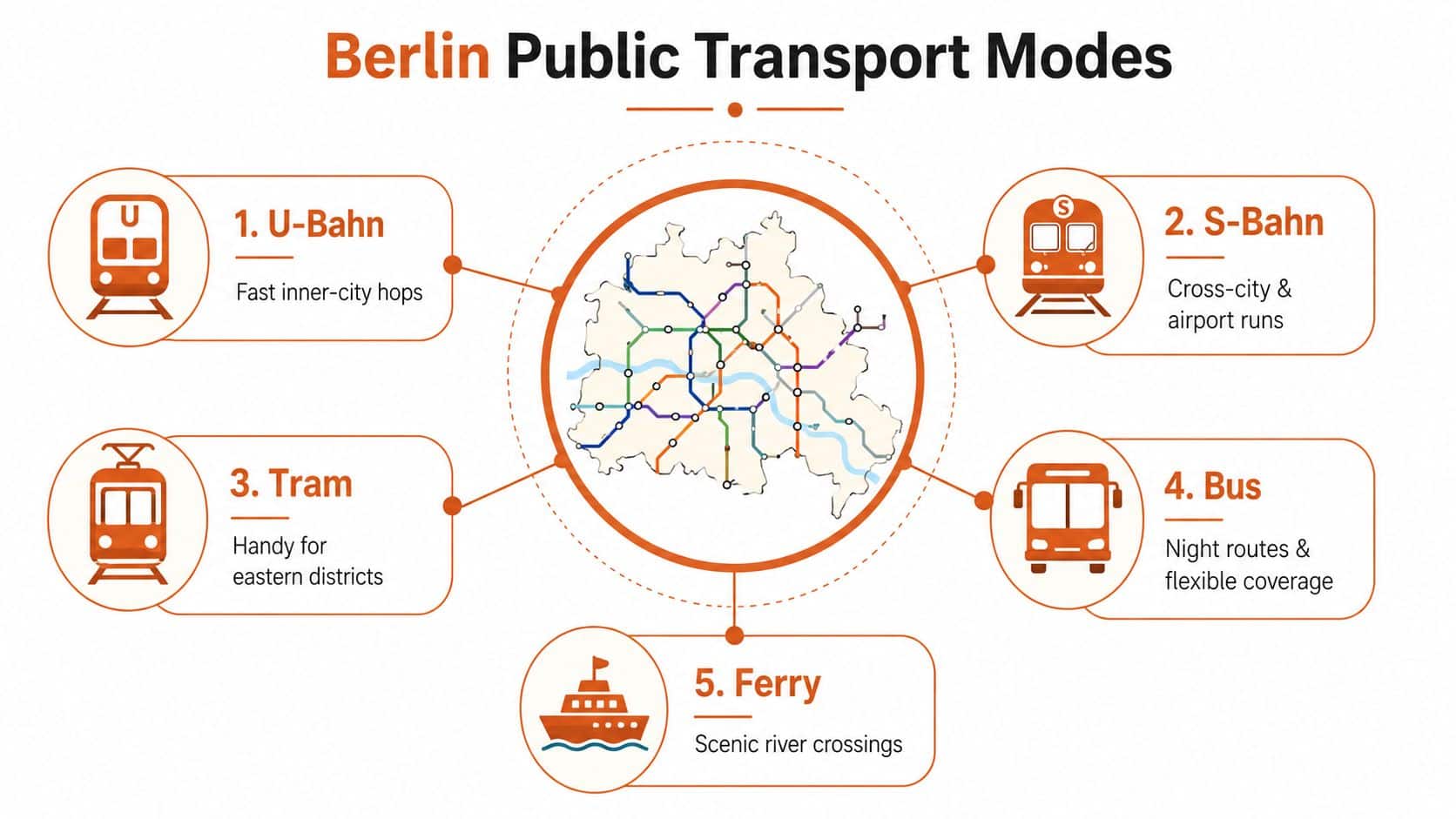
You can feel Berlin's transport logic the moment you stand under a U-Bahn sign in Mitte and realise another train, tram, or bus is usually close by if this one is not the right fit. Berlin runs on a mesh of U-Bahn, S-Bahn, tram, bus, and ferry, and one ticket covers the system within the fare zone you choose.
For a first day, that matters more than transport theory. You are not trying to master the whole network in one go, you are trying to get from your room to breakfast, a museum, and dinner without burning time in traffic or on the wrong platform. Berlin's public transport is how the city moves, and that is why it stays so useful for visitors and locals alike.
Practical rule: if the route feels messy on arrival, do not overthink the map. Pick the nearest station, check the next sensible departure, and get moving. Berlin rewards momentum.
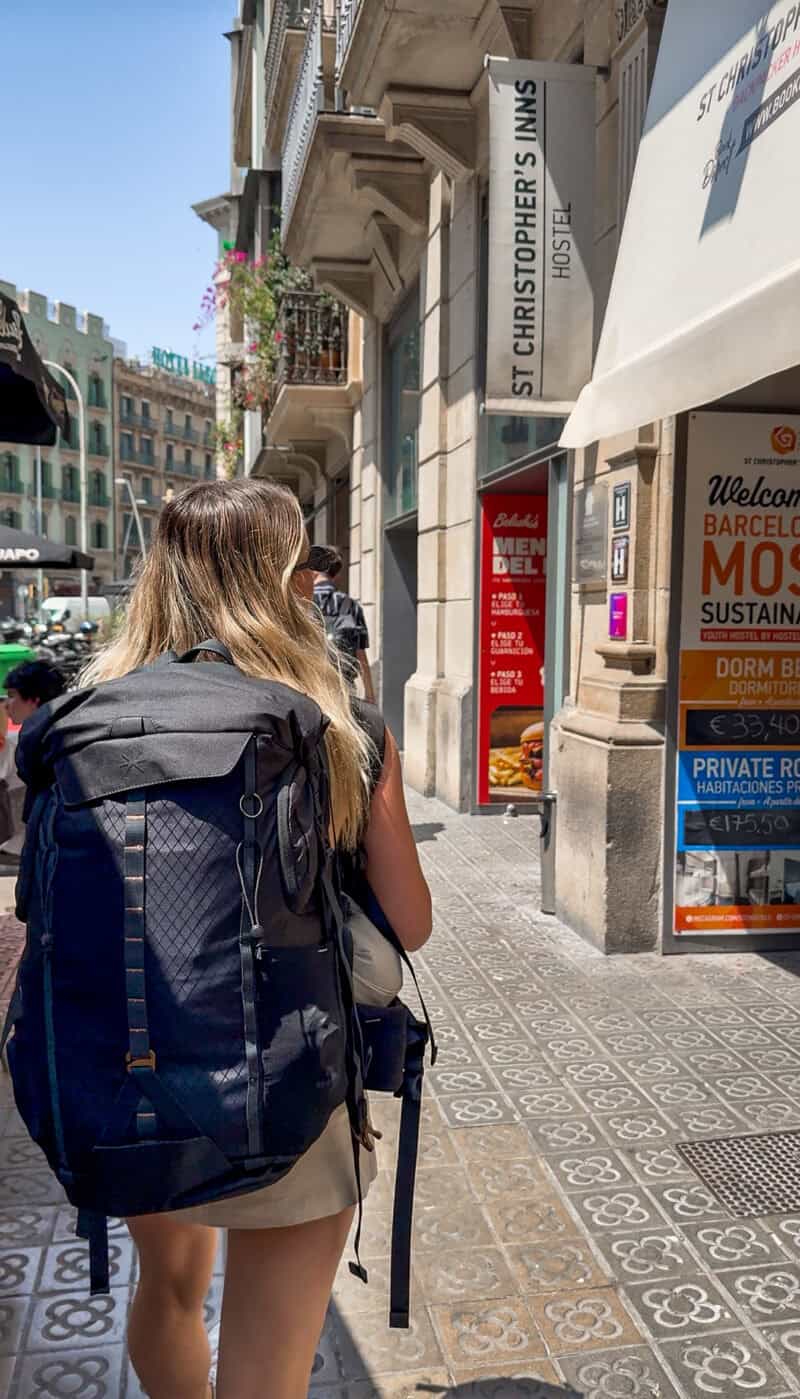
I would also load a map or route app before you leave your room, not after you are already on the platform with a backpack cutting into your shoulder and no signal to spare. A good route app takes the stress out of your first transfer, and if you are landing in a new city after a flight, that small bit of preparation makes the first hour a lot calmer. If you want a quick visual way to get your bearings, use this interactive tourist map of Berlin alongside improving public transit directions.
The main thing is not to treat Berlin like a system built for outsiders. It is a normal city network used every day by people who need to get to work, school, dinner, and late-night trains home. Once you read it that way, the first ride stops feeling like a test, and the rest becomes a set of simple choices. If you are staying centrally, especially around Alexanderplatz or Mitte, the network usually opens up faster than you expect.
The Five Modes and When to Use Each
Berlin's network works best when you match the mode to the job. Pick badly and you waste time switching platforms, walking extra blocks, or riding a line that was never the smartest choice in the first place.
U-Bahn for fast inner-city hops
The U-Bahn is the one to grab for quick trips across central Berlin. It is the underground metro, and it works best when you want speed rather than a view. If you are crossing Mitte, hopping between museum stops, or getting back after dinner without dealing with surface traffic, the U-Bahn is usually the cleanest move.
S-Bahn for cross-city and airport runs
The S-Bahn is the better call when the trip stretches farther out or you need to cross the city quickly. Berlin's S-Bahn covers roughly 330 to 340 km, serves about 166 to 170 stations, and runs at an average speed of about 40 km/h (S-Bahn Berlin). That makes it a strong choice for wider journeys, suburban connections, and airport access.
Use this as your default thinking: U-Bahn for short central hops, S-Bahn for bigger moves across the city.
If you are checking an east-west route or a ride that threads through central Berlin, a guide like this U8 route overview helps you see how the line fits into a real day out.
Trams for the east and for easy above-ground riding
The tram is the practical choice in eastern districts and anywhere you want a calmer, above-ground ride. It also works well when you would rather sit back and watch the neighbourhood change than drop underground again. For visitors, trams are especially handy in Friedrichshain, Prenzlauer Berg, and other areas where they make more sense than forcing a longer rail change.
Buses for gaps, awkward links, and night moves
Buses fill the gaps the rail network does not cover. Use them when the station is a bit too far away, the line does not go quite where you need, or you are coming back late and a night connection is the simplest option. BVG also treats buses as a normal part of the system, not a backup you should ignore (BVG tourist FAQ).
Ferries for actual public transport, not a gimmick
Berlin's ferries are part of the public transport system, not just a novelty. If your route crosses water, they can be a surprisingly pleasant way to get around. Do not treat them like a tourist extra. Treat them as a valid option when the map says they fit.
Choosing the Right Fare Zone for Your Trip
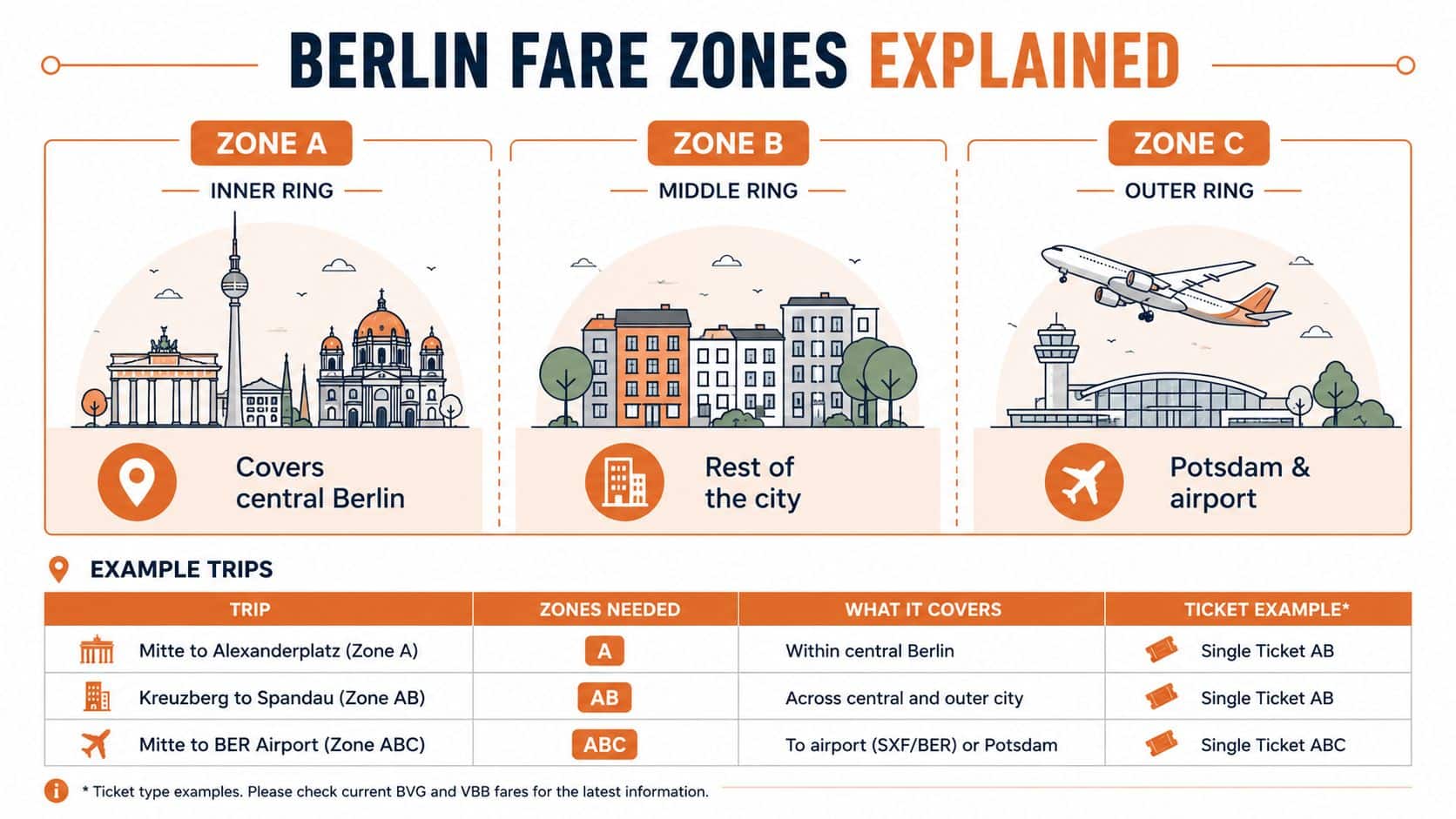
The mistake most visitors make is buying the wrong zone because they think bigger sounds safer. It usually doesn't. Berlin runs on A, B, and C fare zones, and the smart move is to match the ticket to the actual trip, not to your nerves (official city guidance, Berlin zone overview).
Think in trips, not in abstractions
Central sightseeing sits mainly in A and B, while C is the outer layer that reaches places like Potsdam and BER airport. If you're staying in Mitte or Kreuzberg and spending most of your time in the centre, an AB ticket usually fits your day-to-day movement. If you're only making one outer trip, it can make more sense to keep your normal AB setup and deal with that outer journey separately.
That's the honest trade-off. An ABC ticket is useful when you need the outer zone more than once. If not, it can be overkill for a short stay. For a solo traveller on a city break, I'd only go full ABC if the airport, Potsdam, or another outer-area stop is part of the actual plan, not just a maybe.
My rule of thumb: if your base is central and the outer trip is a one-off, don't pay extra just to feel prepared.
A practical decision on the spot
If your day is just museums, food, bars, and back to the hostel, stay with the central zone that matches your route. If you're landing at BER, doing a day trip to Potsdam, or mixing inner-city sightseeing with an outer connection, check whether a separate journey is better value than widening every single trip.
The useful thing about Berlin's fare setup is that it forces you to think clearly about your itinerary. That sounds annoying until you realise it saves money and stops you buying a bigger ticket than you need. If you're moving around like a local, zone choice becomes a quick practical call, not a lecture.
Ticket Types and How to Buy Them
Berlin's ticket system is straightforward once you stop trying to make it clever. Choose by how you'll move around, not by what sounds cheapest on paper. Paper tickets, app tickets, day tickets, and longer passes all have a place, but only if they match your route and how often you'll ride.
Pick the ticket that fits your rhythm
For a short stay, single tickets make sense when you have one or two clear journeys. Short-trip tickets work if you're only going a few stops and do not need the flexibility of a standard ticket. Day tickets suit visitors who will ride several times in one day and do not want to think about every hop.
If you're in Berlin for a few days and plan to move around often, the 7-day travel card can be worth it, especially with a fixed base. The Welcome Card is the tourist option if you want transport and city discounts in one bundle. I would not buy either just because it exists, I would buy it only if your itinerary makes it useful.
Berlin Transport Ticket Options at a Glance
Best For
Zones
Approx Range (EUR)
Single ticket
One clear journey or occasional travel
A, B, or ABC depending on route
Varies by zone
Short-trip ticket
Very short hops
Limited route use
Varies
Day ticket
Several rides in one day
A, B, or ABC depending on route
Varies by zone
7-day travel card
Longer stay with repeated travel
A, B, or ABC depending on route
Varies by zone
Welcome Card
Tourists who plan to combine transport and discounts
A, B, or ABC depending on version
Varies by version
Berlin Pass
Visitors who’ll stack attractions heavily
Depends on purchase setup
Varies
Don’t get caught by the validation rules
If you buy a paper ticket, you must validate it before departure at a stamping machine, because an unstamped ticket is not valid (S-Bahn Berlin visitor information). App tickets work differently, because they are activated digitally, which is one less thing to remember when you are rushing for a platform.
On buses, board at the front. If you are buying from the driver, it is usually cash only, and on trams the onboard machine may take coins only (BVG tourist video guide). That detail matters late at night when everyone else is paying with cards and your wallet is full of the wrong kind of plastic.
If you are comparing bundled options like the Welcome Card or Berlin Pass, use them only if you will use the extras. A pass is not proof that you planned well, it is just maths. If the maths does not work, stick to simple tickets and keep your trip flexible.
Timing Your Travel to Avoid Crowds and Night Surprises
Berlin transport is straightforward in the daytime, then turns more annoying once everyone is moving at the same time. The big mistake is treating 11 a.m. and 11 p.m. like the same trip. They are not, and that difference matters if you are heading home after a bar, a concert, or a late dinner.
Weekday service generally runs from about 4:00 a.m. to 1:30 a.m., while Friday to Saturday and Saturday to Sunday nights run 24 hours (visitBerlin). On weekdays, U-Bahn services stop around 0:40 a.m. and are replaced by night buses at roughly 30-minute intervals. That matters if you are out late, because once the regular trains stop, your backup is no longer the same easy ride you had earlier in the day. The BVG tourist FAQ is the place to check before you rely on a late return.
Peak times are where patience disappears
Skip the crush if you can between 7 to 9 a.m. and 4 to 6 p.m.. If your route goes through Hauptbahnhof or Friedrichstraße, expect crowding and tight boarding windows. Berlin is still usable at those times, just less pleasant and less forgiving.
My rule is simple. If the train looks packed, I walk one stop or wait ten minutes instead of forcing myself onto the first carriage that opens. On short central journeys, that small delay is usually better than standing wedged between a backpack and a suitcase.
Late-night travel needs the same calm approach. Save the night bus route before you go out, especially if you are heading back to a hostel, because trying to figure out a replacement service at 1 a.m. gets old fast when you are tired. A central base cuts down on that hassle, and if you want to see how location changes the whole trip, this Berlin hostel accommodation guide lays out the practical side. The Punk Ride commute guide is also useful for thinking about the first and last bit of the journey, which is where the annoying parts usually start.
Where You Stay Changes How You Travel
A central bed changes your whole transport budget, because shorter trips mean fewer tickets and less time hanging around underground platforms. Staying in Mitte or near Alexanderplatz puts you in the middle of the web, which makes the rest of the city feel smaller than it looks on the map. That’s not marketing fluff, that’s just how the lines are laid out.
If you want a place that works with the network instead of fighting it, St Christopher’s Berlin Mitte sits about 5 minutes from Museum Island, with easy access to the U-Bahn and tram network. St Christopher’s Berlin Alexanderplatz is equally practical when you want a central base and the convenience of Belushi’s downstairs, so you don’t have to cross town just to meet people or grab a drink after a long day. The bar becomes part of the travel plan, not an extra journey.
Good transport stays save more than money. They save the awkward late-night transfer you don’t want to make, especially when you’re tired and carrying too much.
That’s where the first and last mile problem matters in real life. If your hostel is central, the route from station to bed is short, easy, and boring in the best way. If it isn’t, every evening starts to feel like an expedition.
If you want more on that logic, the Punk Ride commute guide is a useful read for thinking about how the gap between transport stop and final destination shapes the whole trip. Berlin is a great city for this kind of practical thinking, because the network rewards people who stay close to it and use it often.
Quick Checklist Before You Tap Through the Gates
Download the BVG app or Jelbi before you leave your accommodation. Doing this at the station wastes time, and Berlin stations are not the place to sort out basic route planning. Top up your contactless card if you plan to pay that way, then decide whether your day fits a tourist pass or a handful of point-to-point tickets.
A mixed itinerary needs a simple plan. If you are hopping between museums, bars, buy the ticket that matches the zones you will cross. If your route changes during the day, keep the fare rules in mind before you board.
Keep this mental checklist handy:
Check the fare zone first. Buy for the area you will use, not the one you hope to stay in.
Stamp paper tickets before boarding. Inspectors fine unstamped tickets on the spot, and arguing about it never helps.
Keep euros in coin form for tram machines. Card payments are not always accepted onboard, so coins save you trouble.
Save your night route before you leave. Late returns are easier when you already know which train, bus, or night service gets you home.
Watch the platform and platform signs. The same stop can serve different lines, and a quick glance avoids ending up on the wrong branch.
Use the system the way locals do. Take the first service that gets you close to where you need to be, then move on with your day. Berlin rewards people who keep the plan simple and stay alert at the gates.
If you’re planning a Berlin trip and want a central base that makes transport easier, have a look at St Christopher’s. You’ll get a practical location, social spaces, and a straightforward setup that works well when you’re using the BVG every day.
Our direct rates are guaranteed to be at least 5% cheaper than anywhere else online, with a free drink on arrival, 25% off food at the bar, and free cancellation options available.