You’ve got the flights tab open, three city names in a Notes app, and a vague feeling that you’re about...
Share This Article
You’ve got the flights tab open, three city names in a Notes app, and a vague feeling that you’re about to overbook yourself. That’s the normal starting point for a European trip, especially if you’re solo, and trying to do more than one sleepy base for a week. The trick is to stop collecting ideas and start making decisions in the right order.
Decide What Kind of European Trip You Want
Before you compare fares or beds, pin down the shape of the trip. A European travel planner only works properly when you know whether you are building a quick city-hopping route, a slower culture trip, or a mixed itinerary with one long stretch and a few shorter stops. Skip this, and you end up comparing trips that are not the same thing at all.
Write a one-paragraph trip brief
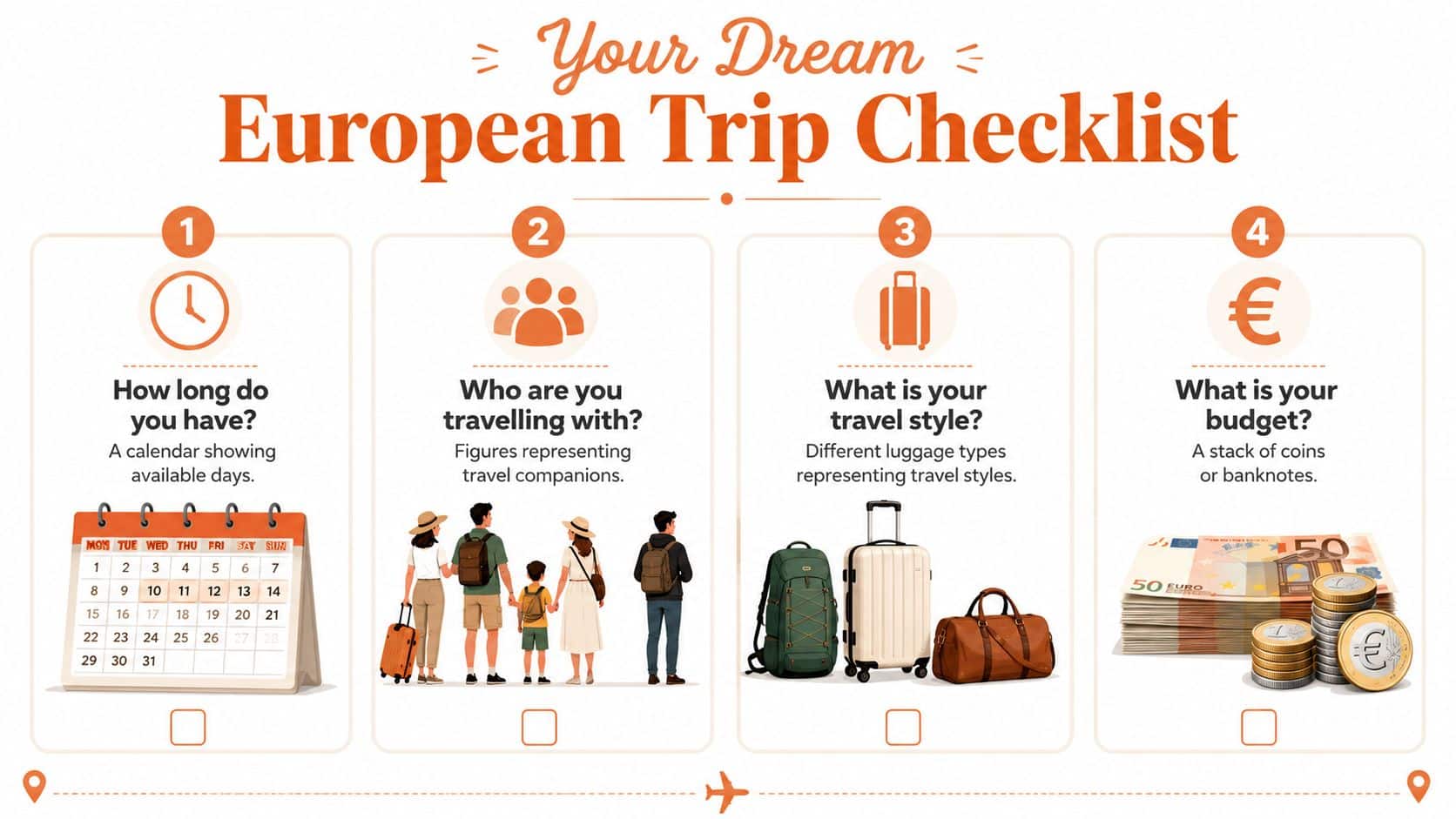
Answer four things in plain English. How long can you be away, who are you travelling with, what do you want most from the trip, and what is your rough budget ceiling in pounds or euros? That is enough to stop fantasy planning from taking over.
Practical rule: if you cannot explain your trip in one paragraph, you do not know it well enough to book it.
Keep the brief blunt. “Ten days, solo, art and nightlife, moderate budget, one rail-heavy loop” is useful. “Somewhere in Europe, maybe five cities, probably cheap” is not.
Match ambition to time and energy
Eurostat’s travel data makes the point clearly. A large share of EU trips are short breaks, and the average trip length sits at around five overnight stays, which is why trying to cram six cities into a week usually feels rotten by day four (Eurostat). The market is built around short, frequent trips, so your plan should respect that rhythm.
For UK travellers, that matters even more if you are balancing work leave, budget limits, and a social trip. If your aim is museums and late dinners, plan for fewer bases. If your aim is movement and variety, city-hop, but keep the route clean and realistic.
Use the quiz before you commit
If you are still unsure whether you are a fast mover or a linger-in-one-place type, use the travel style quiz as a sanity check. It is a decent way to stop yourself booking a route that fights your actual habits.
Build a Route That Saves You Time and Money
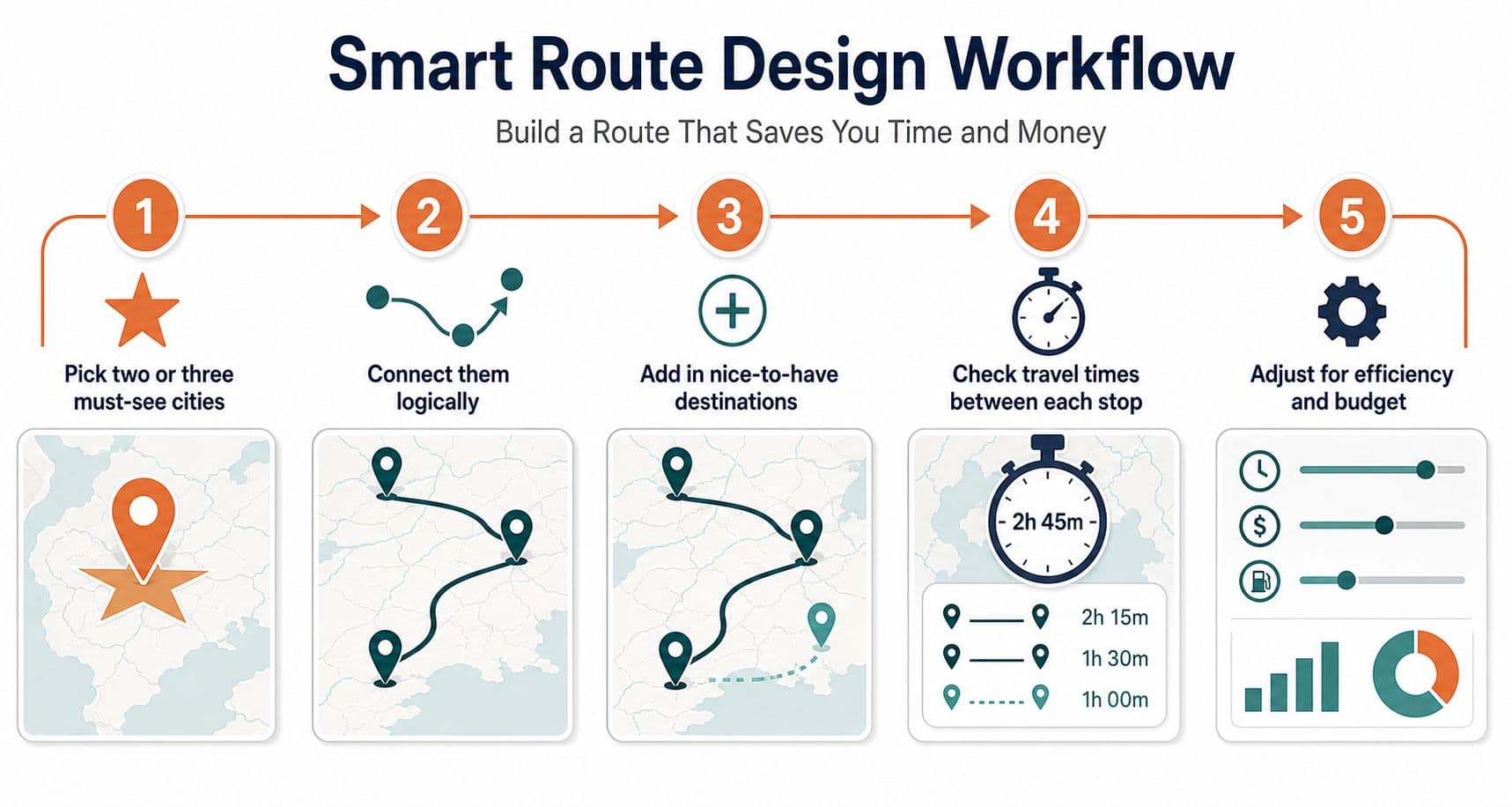
A good route is quiet work. It runs in a clean line or a loop, not a zig-zag that burns half a day on trains and transfers. Rick Steves gives the right advice here, choose the places you actually want, then put them in a sensible order so you are not backtracking for no reason (Rick Steves).
Pick anchors, not a wishlist
Start with two or three anchor cities. These are the places you would be annoyed to miss, and they set the shape of the whole trip. Everything else stays optional until those anchors are fixed.
Once they are set, join them properly. Paris to Amsterdam to Berlin makes sense. Paris to Berlin to Brussels to Amsterdam because somebody liked a café does not. Geography comes first, then your personal priorities.
Give each major stop enough time
European Tourism’s itinerary advice is sensible and unusually practical, choose two or three anchor cities, connect them in a line or loop, give each major city at least two full days, and use an open-jaw flight so you arrive in one city and leave from another (European Tourism). That cuts dead time and usually makes the trip feel calmer. It also gives you breathing space if a train is late or the weather turns grim.
For a classic first-time loop, London, Paris, Amsterdam and Berlin works because the sequence is tidy and the rail or flight legs are manageable. A southern route, Barcelona, southern France and Italy, works for the same reason. The shape stays clean, and you are not bouncing across the continent for the sake of it.
Solo travellers who want to see more than one city should also keep the Schengen 90 days in any rolling 180-day period rule in view. Generic Europe planning advice often ignores it, but your route has to fit the calendar before you start locking in trains and hotels. Map the trip on paper first, then check each country stay against your dates before you book anything.
Direct booking also matters here. If you are moving city to city, you want accommodation and transport that match the route you have chosen, not a bargain that forces a detour or pins you to awkward timings.
Plan the route first, then buy the transport. Reverse that order, and you usually pay for it twice.
Match Your Itinerary to a Realistic Trip Length
The right trip length isn’t about bravado, it’s about how much moving around you can handle before the trip starts to feel like a commute. A week, a fortnight and a month each suit a different style of European travel, and the honest answer is that not everyone needs the biggest version. Sometimes cutting one city makes the whole trip better.
Trip length at a glance
Trip length
Cities
Transport style
Daily budget band
Best for
7 days
2 to 3
Rail or one short flight plus rail
Budget-friendly to moderate
A tight loop with minimal faff
14 days
3 to 4
Rail, overnight train, or one budget flight leg
Budget-friendly to moderate
A proper city-hopping trip without rushing
30 days
5 to 7
Mixed transport, with rest days built in
Moderate to flexible
Slower travellers who want variety and breathing space
A 7-day trip is best spent in two or three cities that sit comfortably together. You want simple transfers and a route that doesn’t eat half a day each time you move. If you only have a week, use it well and accept that you’re buying depth, not coverage.
A 14-day trip is the sweet spot for most solo city-hoppers. It’s long enough to feel like a real loop, but not so long that your laundry and phone data become a subplot. You can do three or four countries if the transport legs are sensible and the city order is clean.
A 30-day trip only works if you respect rest. More travel days mean more friction, more decision-making, and more chances to burn out. If you go that long, keep a couple of lighter days in the middle, or you’ll end up needing a holiday from the holiday.
For route depth, the Eurostat picture supports the logic here. In 2024, 92% of EU residents’ trips were intra-EU, and 65% participated in tourism, which is about 249 million people (Eurostat). Europe is built for regional movement, but that doesn’t mean your own body enjoys six train stations in five days.
Budget Honestly and Spend on the Right Things
The mistake many travelers make is not “spending too much”, it’s spending blindly. They budget for the bed and the flight, then act surprised by local transport, luggage storage, museum tickets and the one night out that somehow becomes three. A proper budget is a split, not a single number.
Build the budget from the bed outward
Eurostat estimates average expenditure at €485 per tourism trip and €97 per night in 2023 (Eurostat). Those figures aren’t a personal budget template, but they do show why accommodation and night-by-night cost control matter so much. On a solo trip, the bed is usually your biggest controllable expense.
Use this rule of thumb. Spend first on location, safety and sleep quality. Spend second on the experiences you’ll remember, such as a good food stop, a day trip, a museum you’ve wanted for years, or a match ticket. Spend last on filler extras that don’t improve the trip.
Move between cities in the way that suits the leg
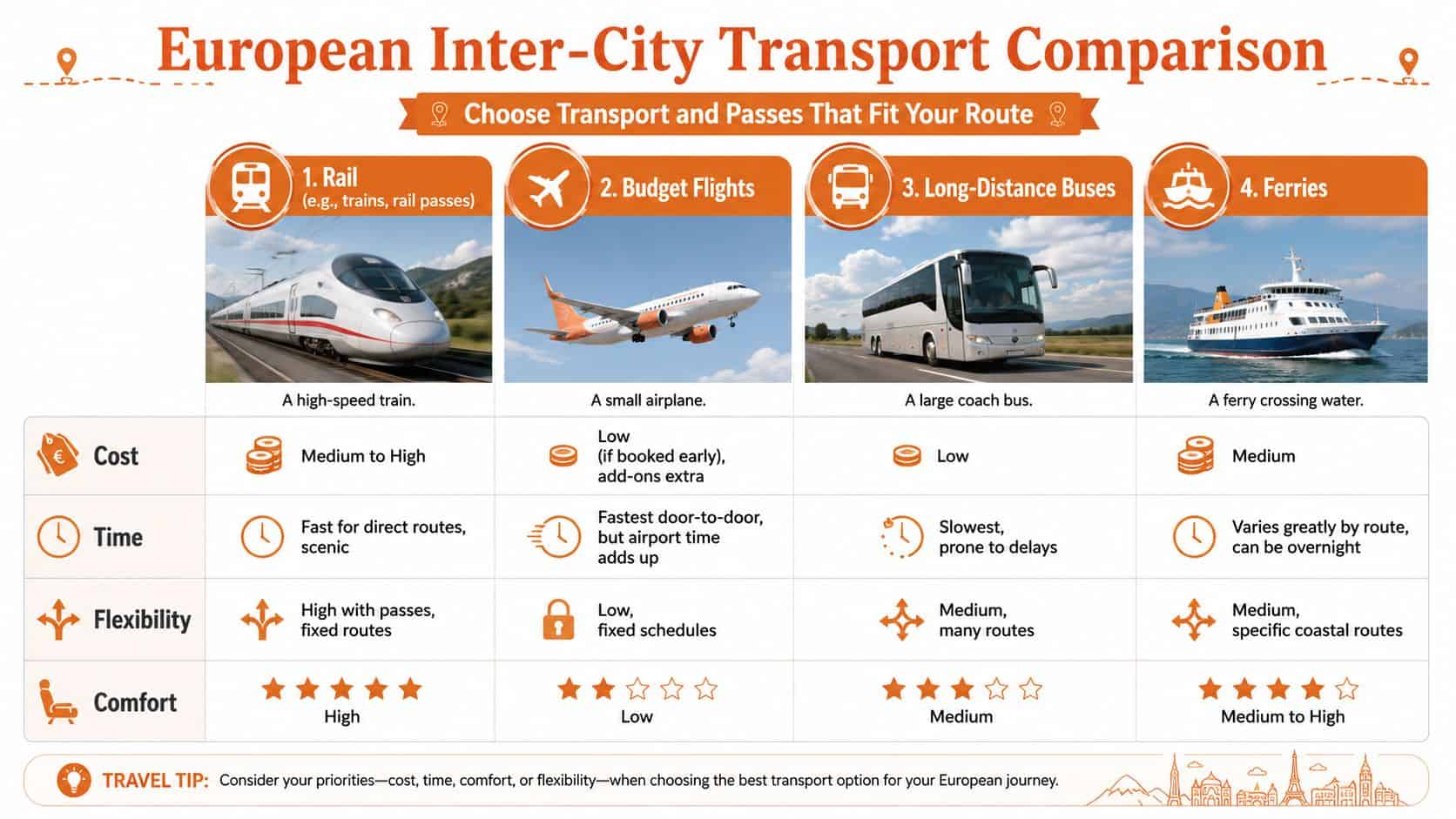
Rail makes sense when the cities sit on a clean line and you want to stay central-to-central. Budget flights work when the rail route is clumsy or the distance is too much for one day. Long-distance buses are the fallback when price matters most and time doesn’t. Ferries are worth it where they effectively connect the route, especially if an overnight crossing saves a bed.
The transport data in the earlier section matters because it stops you romanticising the wrong option. Use the cheapest mode only when it doesn’t turn the day into a slog.
Keep a buffer for the small annoyances
A realistic budget includes local transit, baggage storage, snacks, a contingency pot and the occasional entry fee you forgot to look up. If you’re trying to stay sane, don’t squeeze every pound out of the plan. Leave room for one imperfect day.
Choose Transport and Passes That Fit Your Route
Transport should serve the route, not the other way round. If you start with a rail pass because it feels adventurous, you can end up forcing expensive or awkward detours just to “use it enough”. The EU’s multimodal planner guidance is useful here, because it says a solid planner needs timetable data, door to door routing, ticketing information, disruption data, and travel time, cost and emissions comparison, with interoperability supported by standards such as Transmodel, NeTEx, SIRI and IFOPT (European Commission ITS guidance).
Choose the mode that fits the leg
Rail is usually the nicest answer for central city-to-city hops. It’s fast on direct routes, and you stay in the middle of things. Budget flights are only worth it when they save time overall, not just money on the ticket. Buses are for patience, not glamour. Ferries make sense on coastal or island routes, especially if an overnight sailing replaces a hotel.
The literature on route modelling backs this up. One EU study describes multimodal trip planning as a process that integrates schedule, availability and fare data across air, rail, ferry, long-distance bus and local transport, while using the classical four-step transport framework, generation, distribution, mode choice and assignment (EU study). In plain English, don’t guess. Compare legs properly.
Buy passes only when they really help
Interrail and Eurail passes can be useful on dense rail routes, but they’re not magic. If your route has a few long legs and a lot of fixed city stays, point-to-point advance tickets may make more sense. A pass is a tool, not a virtue signal.
Simple booking rule: if one leg is awkward or slow by rail, don’t force the whole trip onto rail. Mix modes and keep the route clean.
Your bed on a city-hop isn’t just where you sleep. It’s where you dump your bag, dry your clothes, meet people, recover from a late train and work out what to do next. If the location is wrong, the whole trip feels slower. That’s why I’d rather stay central in a good-value place than save a little money and pay for it in taxis and wasted time.
Book direct before you chase price noise
The smartest move is usually booking directly with the property once you know where you want to stay. Many places reward direct bookings with better total value, not just a room rate. On the St Christopher’s site, that can mean perks such as a free welcome drink, 25% off food, free cancellation with cash refund, direct customer service, and a best price guarantee.
St Christopher’s also operates a network of social, central hostels across European cities, with properties in places like London, Paris, Amsterdam, Berlin, Barcelona, Bruges and Edinburgh. Used properly, that kind of base suits solo travellers who want a place to meet people without wandering around town looking for a bar at midnight.
Check the base like a local would
Location comes first. Look for somewhere near a main station, a metro stop or a walkable centre, because that saves both time and transport money. Then check lockers, common areas, clear reception hours and basic safety. If the hostel feels like a maze or sits far out on the edge of town, it’s not a good base for a moving trip.
A strong base also keeps the social side easy. On-site bars matter because you don’t have to leave the building to meet other travellers, and you’re not hunting around a new city when you’re tired. That’s especially useful on solo routes where you want company without booking everything around a group.
Pack for movement, weather and hostel life
Here’s the kit that earns its place in your bag, a padlock, quick-dry towel, earplugs, universal adapter, compact first-aid kit, refillable bottle, layers, passport, insurance details and a photocopy stash. Add a spare payment card and split your cash so you’re not stranded by one lost wallet.
If you need a separate checklist for staying with a pet on the road, this find pet-friendly accommodation guide is a handy extra reference, especially if your trip mixes city stays with a longer stop.
For a calmer budget base, cheap accommodation in Europe is worth reading with a direct-booking mindset, not as a hunt for the lowest headline price.
Lock It In With a Daily Plan and Printable Planner
A good trip usually comes down to a sensible daily rhythm. You don’t need every hour scheduled, but you do need enough structure that moving cities doesn’t turn into a series of decisions you resent. When the basics are set, the trip feels light rather than vague.
Use a day shape that leaves room to breathe
A solid city-hop day looks like this, breakfast near the hostel, one main activity before lunch, a transfer or check-in, then a second lighter plan in the evening. That gives you enough momentum to see something worthwhile without cramming the day. If you’re changing cities, don’t plan a full museum day and a late-night bar crawl on the same travel date.
Book in advance for the things that sell out or save time, major museums, reserved train seats and match tickets. Leave wandering time unbooked. That’s where the good random bits happen, the café, the riverside walk, the tiny gallery, the extra pint you didn’t expect to have.
Keep a planner that fits in your pocket
If you like writing things down, a proper travel journal makes the planning feel real. The travel journal collection is useful if you want one place for dates, bookings and route notes instead of a messy phone screenshot pile. A simple planner page should have these fields.
Route summary: the cities, in order, with arrival and departure dates.
Transport notes: train times, flight references, bus stop names or ferry ports.
Stay details: hostel name, district, station nearest to the property and check-in time.
Must book items: museum tickets, seat reservations, event tickets.
Budget check: what’s already paid and what still needs paying.
Documents: passport, insurance, card backup and any entry requirements.
Keep the last check brutally simple
Should you worry about Schengen days in practice? Yes, if you’re mixing multiple countries over a longer period, because the rule is about the rolling window, not your mood. Is shoulder season usually easier than peak summer? Often, yes, because demand is less brutal and the trip feels calmer. Should you pack a towel? If you’re staying in hostels and moving often, absolutely.
Book the trip tonight if the route feels right, but don’t book a messy route just because the fares look tempting. A neat plan always beats a cheap-looking mistake.
St Christopher’s gives solo travellers central bases, social spaces and direct-booking value across key European cities, which fits city-hopping far better than a random one-base setup. If you want an easy place to start turning a rough route into a proper trip, visit St Christopher’s and build your stops around places that make moving around Europe simpler, not harder.
Our direct rates are guaranteed to be at least 5% cheaper than anywhere else online, with a free drink on arrival, 25% off food at the bar, and free cancellation options available.